British Army successfully tests new drone-destroying laser
First ever UK high-energy laser weapon system mounted on an armoured vehicle at a UK trials range.
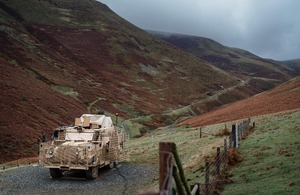
Wolfhound Vehicle with Laser Directed Energy Weapon
A high-energy laser weapon has been fired by the British Army from an armoured vehicle for the first time and successfully destroyed flying drones.
It works by directing an intense beam of infra-red light in the form of energy towards its target using advanced sensors and tracking systems which maintain lock-on and accuracy in real time.
Unlike conventional munitions, laser weapons are virtually limitless in terms of ammunition supply, which means they could represent a cost-effective alternative to some current in-service weapons.
The laser was integrated onto a Wolfhound – a protected troop-carrying vehicle - where soldiers from 16 Royal Artillery were able to track and down hovering targets at Radnor Range in mid-Wales.
Minister for Defence Procurement and Industry, Maria Eagle MP, said:
“This ground-breaking technology demonstrates Britain’s commitment to staying at the forefront of military innovation.
“The successful testing of this laser weapon system represents a significant step forward in our development of possible future defence capabilities and showcases British engineering excellence.”
The laser has been developed through a collaboration between the MOD’s Defence Equipment & Support (DE&S) and Defence Science and Technology Laboratory (Dstl) – known as Team Hersa – and an industry consortium led by Raytheon UK.
This delivers on the Government’s Plan for Change, by rapidly advancing technologies and building on the strong foundation of national security.
Warrant Officer Matthew Anderson, trials manager for the British Army’s Mounted Close Combat Trials and Development Group, said:
“Every engagement we’ve done has removed a drone from the sky. While we’ve been testing a variety of distances, speeds and altitudes, one thing has remained – how quick a drone can be taken out.
“It’s definitely a capability that could be added to the arsenal of weapons that we use on the battlefield.”
The purpose of the capability demonstrator programme is to discover and test the potential future use of directed energy weapons by the British Army.
Having already been tested by engineers from MOD and industry, the latest experimentation by the British Army should provide knowledge, information and experience to support future requirement decisions, ensuring the UK stays at the forefront of this novel and disruptive technology.
Stephen Waller, Directed Energy Weapons Team Leader for DE&S, said:
“This is still an emerging technology, but the world has changed and we are seeing more use of drones in the battlespace. This requires a more cost-effective solution to protect our troops.
“Having the capability to track and eliminate moving drones will give UK troops a better operational advantage and these successful trials have demonstrated that we are well on our way to achieving this.”
As well as Raytheon, Fraser Nash, NP Aerospace, LumOptica, Blighter Surveillance Systems and Cambridge Pixel have been involved in developing the weapon under a £16.8 million contract awarded by Team Hersa.
UK MOD will take the learnings of the project into account and assess the necessary steps to develop Laser Directed Energy Weapons for frontline use by the British Army in the future.
Matt Cork, Head of Team Hersa Dstl said:
“The successful testing of the Laser Directed Energy Weapon demonstrator is an important step towards a future capability. This technology has the potential to offer a credible and cost-effective means to defeat a range of current and future threats, which would improve the effectiveness of our armed forces”