
Calculating salary thresholds: technical note 19 May 2026 (accessible)
Updated 19 May 2026

© Crown copyright 2026
This publication is licensed under the terms of the Open Government Licence v3.0 except where otherwise stated. To view this licence, visit or write to the Information Policy Team, The National Archives, Kew, London TW9 4DU, or email: psi@nationalarchives.gov.uk.
Where we have identified any third party copyright information you will need to obtain permission from the copyright holders concerned.
This publication is available at /government/publications/calculating-salary-thresholds-technical-notes/calculating-salary-thresholds-technical-note-19-may-2026-accessible
19 May 2026
Introduction
1. The Migration Advisory Committee (MAC) have previously provided advice to the Government on the level and design of salary thresholds in the immigration system[footnote 1]. For routes that apply salary thresholds, employers wishing to sponsor migrants to fill vacancies in eligible occupations must meet minimum salary requirements. Except for some largely public sector occupations, where salary thresholds are set in line with national pay scales, salary requirements are set as the higher of a general threshold and an occupation-specific threshold.
2. This technical note sets out the methodology we recommend for how these thresholds could be calculated and provides illustrative examples. It is the responsibility of the Home Office to set the salary thresholds.
3. This note provides an update to the MAC’s original technical note on salary thresholds, published in 2020[footnote 2]. As the MAC has previously recommended, the salary requirements should be updated annually in line with the latest wage data. To minimise year-on-year volatility, particularly in the case of occupations with small sample sizes in the survey data, this updated note applies a smoothing method to the occupation-specific thresholds.
4. Whilst this note focuses on the Skilled Worker route, the same principles for smoothing occupation-specific thresholds apply across other routes.
General threshold
5. The general threshold for the Skilled Worker route is calculated as a chosen percentile on the distribution of annual earnings across all eligible occupations[footnote 3] using the latest available Annual Survey of Hours and Earnings (ASHE) dataset[footnote 4]. The observations over which the percentile should be calculated are those employees who are at least 16 years old, work full-time, are on adult rates, and have been in the same job for more than one year[footnote 5]. Where only a subset of an occupation is eligible for the route, the full occupation should nonetheless be included in this calculation because role level data is not available in ASHE.
6. Setting the Skilled Worker general threshold at the 30th percentile of the full-time annual earnings distribution for all eligible RQF6+ non‑pay‑scale occupations, produces a general threshold of £44,000 (rounded to the nearest £100) using ASHE 2025.
Occupation-specific thresholds
7. Unlike the general threshold, which the MAC recommends should be derived from the full‑time earnings distribution across all eligible occupations combined, occupation‑specific thresholds should be set at a chosen percentile of the full‑time earnings distribution for each eligible occupation, where occupations are defined at the 4-digit Standard Occupational Classification (SOC) code level.
8. Suppose the occupation-specific thresholds are set at the 25th percentile. To begin calculating a smoothed threshold set at this level, first we must find unsmoothed values for the occupation’s 25th percentile in the current year and years prior. Where possible, these unsmoothed values should be taken directly from the latest ASHE tables published by the Office for National Statistics (ONS), specifically Table 14.7a[footnote 6]. However, there will be some occupations where no estimate of the 25th percentile is published due to concerns around its robustness given the limited sample size available within ASHE.
9. Two approaches are used to overcome this issue:
a) Historic ratio between median and 25th percentile
Using the published tables in the three years prior to the most recent ASHE publication, the ratio of the median and 25th percentile is calculated and averaged over each of the years for the relevant occupation where enough data was published to do so.
This ratio is then applied to the estimate of median earnings in the latest ASHE publication to generate an estimate of the 25th percentile.
This method can only be used when there is at least one year where both a median and 25th percentile estimate is published in the previous three years and when an estimate of the median is published in the most recent data.
b) The discount/premium between unit and minor occupation groups
Using the underlying ASHE data, the percentage difference between the 25th percentile of annual earnings for each unit occupation group (4-digit) and minor occupation group (3-digit) is calculated for each of three years – the latest available and the two previous years. The differences across those three years are then averaged to produce an estimate of the discount/premium in earnings between a unit group occupation and its associated minor group.
This average discount/premium is then applied to the published 25th percentile estimate for a minor group to get an estimate at the unit group level.
When no 25th percentile estimate for a minor group is published then the discount/premium between the sub-major group (2-digit) and the unit group is used instead.
When no 25th percentile estimate for the sub-major group is published then the discount/premium between the major group (1-digit) and the unit group is used instead.
10. No statistical measure of accuracy is reported for these estimates.
11. Wherever possible, salary thresholds should be derived from published data so that users of the system can see exactly where the requirements come from. Accordingly, method (a) is preferable to method (b). However, where method (a) cannot produce an estimate, method (b) should be used instead. Of course, if the occupation-specific thresholds are set at the median rather than the 25th percentile, method (a) cannot be applied; method (b) would therefore be used by default if no estimate of the median is published within ASHE.
12. In the same way that occupation‑specific thresholds imputed using methods (a) or (b) are made less volatile from year-to-year because they draw on multiple years of data, applying smoothing across all occupations provides an additional stabiliser, reducing the risk of sharp annual movements in requirements for employers driven by noise in the data.
13. For a given occupation, the MAC recommends the smoothed occupation-specific threshold calculated as a weighted average of the current year’s unsmoothed threshold and uprated values of the two preceding years’ unsmoothed thresholds (irrespective of whether any or all three unsmoothed thresholds were published estimates or had to be imputed using method (a) or (b)). Prior‑year values should first be brought to the current year’s wage level using the change in the general threshold as the uprating factor. The precise steps are as follows:
a) Uprate prior years’ unsmoothed thresholds to the current‑year level.
For occupation Ìýand current year :
- Let T j,t be the unsmoothed occupation-specific threshold in year t.
- Let Gt Ìýbe the general threshold in year t.
- Uprate the two prior years’ unsmoothed thresholds using the ratio of the general threshold in each prior year to the general threshold in the year t:
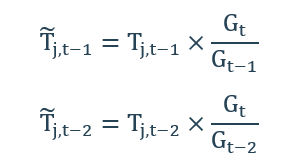
- Note: The definitions of the general threshold and occupation-specific threshold should be applied consistently for uprating, even if different percentiles were used operationally in those earlier reference years.
b) Compute the weighted average of the scaled-up unsmoothed thresholds from the two previous years and the current year.
- Form the smoothed occupation specific threshold as:

- That is, weight the current year at 0.5, the previous year at 0.3, and two years prior at 0.2, to better reflect more recent labour market conditions. This procedure should be applied to all occupations, irrespective of their sample size.
Illustrative Examples
Imputing using method (a): Aerospace engineers - 2126
There was no estimate of the 25th percentile of annual full-time earnings published for Aerospace engineers in the 2025 ASHE tables. An estimate for the median (50th percentile) was published – £55,839.
Using published estimates from 2024, 2023 and 2022, we calculate that the average ratio between the median and 25th percentile of Aerospace engineers’ earnings distribution is 0.817 – calculations shown below.
| Year | 25th Percentile | Median | Ratio |
|---|---|---|---|
| 2022 | £35,129 | £42,871 | 0.82 |
| 2023 | £38,938 | £46,379 | 0.84 |
| 2024 | £43,184 | £54,504 | 0.79 |
Average: 0.817
Source: Table 14.7a ASHE 2022, 2023, 2024
Applying this ratio to the 2025 estimate of median earnings results in a value of £45,600 to the nearest £100. This would be the value of the unsmoothed occupation-specific salary threshold for Aerospace engineers.
Imputing using method (b): Probation officers - 2462
There was no estimate of the 25th percentile of annual full-time earnings published for Probation Officers in the 2025 ASHE tables, nor of the median (50th percentile).
Between 2021 and 2025 the ONS only published an estimate of the 25th percentile once, in 2021. This is insufficient for us to be able to use the ratio method illustrated above for Aerospace engineers.
We therefore turn to the microdata that underlies the published ASHE tables. Using this data, we extract estimates of the 25th earnings percentile for Probation officers. We also extract estimates of the 25th earnings percentile of the minor occupation group Welfare Professionals (246) of which Probation officers are a part. Calculating the difference between these three pairs of numbers and averaging across them results in an estimated earnings premium of around 0.226% for Probation officers over Welfare Professionals more generally.
Applying this premium to the published 25th percentile estimate for Welfare Professionals results in a value of £33,600 to the nearest £100. This would be the value of the unsmoothed occupation-specific salary threshold for Probation officers.
Smoothing occupation-specific thresholds: IT business analysts, architects and systems designers - 2133
An estimate of the 25th percentile of annual full-time earnings published for IT business analysts, architects and systems designers was published in the 2025, 2024 and 2023 ASHE tables. However, the process would be methodologically identical even if the occupation’s 25th percentile wage was imputed using method (a) or (b), for any, or all of, the current and preceding two years.
The table below shows how the smoothing method would be applied to 25th percentile estimates for IT business analysts, architects and systems designers to obtain the occupation-specific threshold, assuming the general threshold were set at the 30th percentile of full-time earnings across combined RQF6+ occupations.
| Step | 2023 | 2024 | 2025 |
|---|---|---|---|
| Occupation’s 25th percentile wage | £40,178 | £42,356 | £45,860 |
| RQF6+ 30th percentile wage | £38,997 | £41,667 | £44,026 |
| RQF6+ adjustment factor (relative to 2025) | 1.13 | 1.06 | 1.00 |
| Weighting | 0.20 | 0.30 | 0.50 |
| Occupation’s threshold inflated to 2025 equivalent | £45,360 | £44,755 | £45,860 |
Occupation’s 2025 smoothed threshold: £45,400
Source: Table 14.7a ASHE 2023-2025
Note: The RQF6+ adjustment factor figures are stated to 2 decimal places, but the unrounded figures are used in the calculations.
As shown, the occupation-specific threshold with smoothing applied would be £45,400, to the nearest £100.
-
Ìý↩
-
Ìý↩
-
Eligible occupations for the Skilled Worker route are taken to be those listed as skilled to RQF level 6 and above in the Immigration Rules Appendix Skilled Occupations.Ìý↩
-
Ìý↩
-
Additionally, employees who do not have a valid work region, or who have missing or zero annual gross salaries are also not included. This is in line with annual earnings estimates published by the ONS. ASHE data are weighted to produce estimates for the UK.Ìý↩
-
Ìý↩