Creative Industries business growth and access to finance discovery report
Published 16 July 2026

Ā© Crown copyright 2026
This publication is licensed under the terms of the Open Government Licence v3.0 except where otherwise stated. To view this licence, visit or write to the Information Policy Team, The National Archives, Kew, London TW9 4DU, or email: psi@nationalarchives.gov.uk.
Where we have identified any third party copyright information you will need to obtain permission from the copyright holders concerned.
This publication is available at /government/publications/creative-industries-business-growth-and-access-to-finance-discovery-report/creative-industries-business-growth-and-access-to-finance-discovery-report
A TPXImpact report for the Department for Media, Culture and Sport.
Summary
Creative businesses face a complex, fragmented finance landscape with inconsistent, lengthy processes and a lack of clear criteria for accessing finance.Ģż
The single front door (SFD) must act as a holistic umbrella and navigator to simplify this landscape, and not become another silo within it.Ģż
The key value proposition the SFD offers is to guide founders to appropriate finance options and give them the knowledge and tools to access them effectively. At the core of this is matching founders with suitable investors, helping both parties save time and wasted effort by increasing the likelihood of successful finance partnerships.
Our 11 week discovery used qualitative research methods to identify 46 founder needs driven by four core challenges: systemic barriers (risk, uncertainty and control), a fundamental disconnect (investor/founder understanding), operational friction (administrative burden and cashflow), and a need for trusted expertise. These findings define the SFDā€™s recommended service stages: discover finance options, understand finance, and access/apply for finance.
Weā€™ve designed the outputs to act as framework and guide to support the future development of the single front door where the needs of founders must be incorporated to shape the delivery outcome.
Project background and overview
This research has been commissioned by the Department for Culture, Media and Sport (DCMS).
Our goal
To understand how growing creative businesses navigate their investment options to create a clearer pathway through their business growth journey.Ģż
This will inform the definition and design of an industry-led ā€œsingle front doorā€ (SFD) for creative businesses to access investment to enable them to scale up, which was announced within the Creative Industries Sector Plan.
Discovery outcome
Insights will shape recommendations for the SFD to ensure that the service is rooted in the needs and behaviours of business leaders and that it makes the funding and investment process easily navigable by creative businesses.Ģż
It will also help to clarify support routes for businesses across the emerging government offer in response to key changes related to the Growth Mission including the UKā€™s Modern Industrial Strategy and the governmentā€™s plan for small and medium sized businesses
Discovery objectives
- Understand the ā€˜as-isā€™
- We sought to map the current landscape and understand the needs of creative industries businesses and how they find and navigate their finance options.
- Identify key gaps and barriers
- We wanted to identify pain points, existing gaps and success factors that founders encounter within the investment landscape.
- Explore the role of support
- We wanted to explore how and why businesses use different forms of support and the outcomes.
- Present evidenced ideas for the single front door
- Our key objective was to create a synthesised body of evidence to shape and support recommendations for what a single front door could be.
The problem weā€™re trying to solve
Creative founders are forced to navigate a fragmented and ā€˜noisyā€™ finance landscape that is misaligned to the needs of the creative industries
The as-is landscape offers information without context and finance options full of friction and uncertainty. It drives founders into navigating through all options and hoping for the best, seeking a ā€œmosaicā€ of finance to hedge their bets.
Founders spend disproportionate time translating their value, making sense of inconsistent jargon and searching for misaligned finance products, which impacts their ability to access finance.
Understanding the as-is landscape
Creative industries access to finance map
We were asked to create a clear visual representation of finance sources currently available to businesses within the creative industries.Ģż
The Creative Industries Finance Map captures a moment in time of the as-is landscape. Itā€™s an interim tool for creative businesses to see, access and explore the finance options available. The map can be used to help shape the single front door.
How we created the finance map
The finance map was created based on industry knowledge and desk research. We plotted organisations that provide finance or support to the creative industries against a business growth scale as a snapshot of the as-is landscape.
Itā€™s been published on °Ēøē³Ō¹Ļ. Businesses can use the map to navigate the finance sources available. We used it to help inform our research questions and focus.
In addition, we carried out pop-up research at (17/02/26) - 8 hours of engagement with a large number of delegates from a wide range of creative businesses, investors and other organisations. We captured feedback on the map to inform the second iteration, and had wider discussions that have fed into our insights and needs development.
Feedback
Creative Industries Council shared the map on LinkedIn.
As of 2 July 2026, the map has:
- 320 likes
- 32 comments
- 93 reposts
The map received lots of :
What a fantastic resource!
A useful snapshot of what exists. The real opportunity now is embedding capital sequencing, blended finance logic and place based routing so the front door becomes a deployment tool, not just a map.
I really enjoyed my conversation with the team at the Creative UK Investment Summit last week - great work and very useful.
Thank you! Itā€™s a very helpful resource that supports creatives on their journey and helps them succeed.
Brilliant! Just what we need. So clear and easy to navigate!
Brilliant work demonstrating the breadth of finance available and more to come!
This is so useful.
Research
Research approach
Multi-method qualitative discovery
We used a range of qualitative methods to ensure we looked at the problem space from different perspectives, enabling us to triangulate our findings and identify consistent patterns.
Desk research
Mapping the policy and finance landscape and learning from existing research.
Depth interviews
Detailed exploration of 10 creative business foundersā€™ experiences.
Pop-up research
Reaching the wider creative community, investors and delivery partners at the Big Creative UK Investment Summit.
Stakeholder engagement
Sharing knowledge and stress-testing our findings with delivery partners (Create Growth Programme regional teams, Creative UK, Innovate UK Business Connect).
Methodology
Depth interviews
- 10 creative industries founders
- 60-minute semi-structured interviews (via Google Meet)
- Varied sample across sub-sectors, growth stages and UK regions
- Post-interview thematic analysis
- Synthesis across all interviews and insight development
Pop-up research
- Located prominently within the expo at the Big Creative UK Investment Summit
- Short, in-person discussions with creatives, investors and intermediaries
- Prototype Creative Industries Access to Finance Map used as a visual stimulus
- Feedback captured on post-it notes
- Thematic analysis and synthesis with other research insights
Who we spoke to
Depth interviews
Creative business leaders
- 10 founders
- 5 sub-sectors: Advertising and Marketing; Createch; Film and TV; Music, Performing and Visual Arts; Video Games
- 4 regions: East Anglia, Gt. Manchester, Southampton, Scotland
- 4 growth stages: 1 scale, 4 growth, 2 early, 3 seedĢż
Pop-up research
- 8 hours of discussions with a wide range of creative founders, private investors, business support organisations and delivery partners at Big Creative UK Investment Summit.
Depth sample designed for maximum insight
The objective of qualitative research is to generate deep insight, not statistically representative data. Our sample was designed to provide maximum variation to capture similarities and contrasts across business growth stage, sub-sector and regions. We:
- focussed on the highest growth potential creative sub-sectors (+createch).
- selected four diverse regions based on levels of funding and support intervention to drive out regional contrasts without fragmenting the sample too much (*West Midlands excluded to avoid cross-over with a concurrent Creative UK study).
- achieved a good spread of different growth stages, from seed to scale.
- ensured each candidate was unique across the variables.
- met our aim to create a sample mix that enabled triangulation of findings to identify consistent patterns.
Our data was supplemented by engaging with a wider sample during pop-up research.
How we made sense of the data
We synthesised the interview transcripts and observer notes through a four-stage thematic analysis:
- distilled the specific who, what, where, when, how and why detail from each founderā€™s story
- identified recurring themes, frictions and differences across the sample
- clustered related findings into 11 core insights and the user needs they represent
- grouped these into four overarching themes that define the challenges and opportunities for the single front door
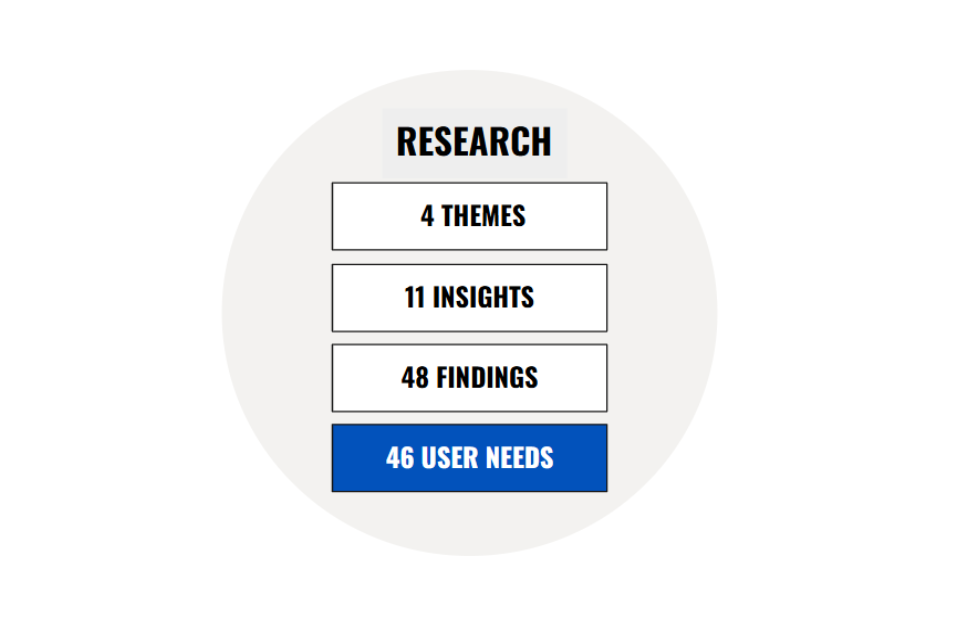
This graphic shows how the data collected during the research phase is structured in the report.
Research breakdown:
- 4 themes
- 11 insightsĢż
- 8 findings
- 46 user needs
Segment analysis
As part of our research, we explored whether foundersā€™ experience varies by location, sub-sector and business maturity. While access to services and finance models differ, the core pain points remained remarkably consistent across our entire sample.
Our interviews revealed an extra dimension to our segmentation: each founderā€™s own level of business experience (their personal ā€˜maturityā€™). Interestingly, even seasoned, business savvy founders share many of the same frustrations as beginners. This suggests the problem isnā€™t just a lack of knowledge, but system-wide complexity that hampers everyone.
Implications for the single front door
The single front door canā€™t be a one size fits all repository for information, but must enable founders with different needs and criteria to navigate to relevant content and services.
The variation in content across sub-sectors, regions and business and personal maturity is one layer of a personalised journey which should focus on the intention of the user - what they are seeking to achieve.
What we found
-
Theme 1: Creative founders navigate systemic barriers and friction by layering different sources of finance.
-
Theme 2: There is a fundamental disconnect between foundersā€™ and investorsā€™ needs, understanding and expectations creating a two-way barrier to investment.
-
Theme 3: Accessing grants and loans is a source of significant operational friction, with administrative burden and available products not always compatible with business needs.
-
Theme 4: Accessing finance is not just a discovery challenge - itā€™s the navigation, interpretation and next steps where founders find true value in trusted, sector-specific expertise.
Theme 1: Creative founders navigate systemic barriers and friction by layering different sources of finance
What we learned:
- Businesses seek multiple finance sources strategically to manage timing, risk and uncertainty.Ģż
- Founders may actively avoid equity investment to retain control, using grants and debt as alternatives.
±õ³¾±č±ō¾±³¦²¹³Ł¾±“Ē²Ō:Ģż
- Improving navigation to finance via the single front door is essential, but it will only be effective at improving access to finance and driving growth if the individual issues within the funding opportunities themselves are addressed.
Insight 1: Businesses seek multiple finance sources strategically to manage timing, risk and uncertainty.
Research findings:
- Mosaic financing* is a survival strategy deliberately employed to maximise success in funding product development and growth.
- Founders hedge their bets as they are aware of time lags, grant failure rates and challenges finding investors.
- Some opportunism as founders ā€˜stumble acrossā€™ funding sources - suspicion among some that peers change tack to fit the criteria.
*ā€˜Mosaic financingā€™ is often described as portfolio financing, however weā€™ve used this term to highlight the way in which founders are piecing funding options together to mitigate the pros and cons of each and create a coherent finance picture.
Quotes:
You fire a lot of arrows - you donā€™t have time to try one and then wait and then try the next one.
I started the loan applications because I know how difficult it is to get funding and it takes a long time. Angels, which is what weā€™re looking for, are individuals and negotiations can be complicated. You canā€™t rely on it.
Single front door service needs (As a creative founder):
- I need a clear view of the finance thatā€™s available to me and the implications of different choices
- so that I can plan a finance mix that aligns with my growth strategy and allows me to manage risk.
- I need to know what grants I am eligible for that are available now or are upcoming,Ģż
- so that I can make a strategic decision as to whether to factor these into my funding mix.
- I need funds and finance products that have been designed to remove unnecessary friction and time lags
- so that I can make finance decisions based on whatā€™s actually best for my business and not just whatā€™s easiest to access.
Insight 2: Some founders actively avoid equity investment to retain control, using grants and debt as alternatives.
Research findings:
- Founders have walked away from deals because of investor ā€˜meddlingā€™.
- Poor choice of investor or matchmaking blamed for relationship failures.
- Mismatch of investorsā€™ and foundersā€™ exit timeframe expectations has an impact.
- Some now using debt or grants to supplement revenue as they(?) have been putting off private investment altogether.
- Single purpose vehicles and project-based financing being used to isolate the investable product or protect the IP.
Quotes:
There was a clause saying they would have creative control - I didnā€™t want to sign that.
Having a small agile team making independent games can be appealing, whereas investors want you to scale up and they want to exit in three to five years.
Too many people go for investment too early and it stifles creativity. If you can bootstrap do - the minute you get investment you lose control.
Because of dilution and multiple investment rounds investors had the majority control of the business and took us down a sale path that we strongly believe the company wasnā€™t ready for.
Single front door service needs (as a creative founder):
- I need a way to find and match with investors based on shared values and ways of working
- so that I can be confident that we can agree the right level of control and input for both parties.
- I need help to understand the terms of investment propositions including creative control and IP ownership
- so that I can identify any ā€˜deal breakersā€™ early in the negotiation process.
- I need to see examples showing how to scale using a mix of debt, grants and revenueĢż
- so that I can plan a legitimate alternative to the VC-track if that is not right for me.
- I need to understand how to use project-specific structures (like SVPs) to ring fence my assets
- so that I can get investment for a single project without it impacting the equity or control of my parent company.
Theme 2: There is a fundamental disconnect between foundersā€™ and investorsā€™ needs, understanding and expectations creating a two-way barrier to investment.
What we learned:Ģż
- Some investorsā€™ limited understanding of creative business models creates misaligned expectations and barriers to investment.Ģż
- ā€˜Investment readinessā€™ lacks a shared definition, creating a misalignment between founder preparation and investor expectations.Ģż
- Finance terminology does not align with how creative businesses think about growth and funding.
±õ³¾±č±ō¾±³¦²¹³Ł¾±“Ē²Ō:Ģż
- Improving access to investment needs action to build trust and understanding between creative businesses and investors, and support the evolution of a shared culture of investment-readiness and mutual value.
Insight 3: Some investorsā€™ limited understanding of creative business models creates misaligned expectations and barriers to investment.
Research findings:
- Founders have experienced a lack of understanding among generalist investors.
- Investors who donā€™t understand the creative sector try to apply inappropriate metrics that donā€™t reflect the business.
- One live performance company felt they were being assessed against SaaS criteria.
- A SaaS business had ā€˜creative cloudā€™ valued as if it were standard B2B software.
- Purpose-led businesses feel at a disadvantage as itā€™s assumed they arenā€™t focussed on ROI.
- Failed investments may be because of poor knowledge of the business but give creative industries a bad name.
Quotes:
Private equity is hard to access as investors donā€™t understand what we do or its value.
It does no one any good to have ā€˜dumb moneyā€™ coming in and being lost. It ends up with the message ā€˜donā€™t go near this industryā€™. Music is a classic - people invest because they fall in love with the music without knowing anything about the business.
Single front door service needs (as a creative founder):
- I need a common understanding of creative business models with potential investors
- so that I am not evaluated against benchmarks that arenā€™t relevant to my sector (e.g. software development).
- I need to understand how to translate my experience of ā€˜selling to a customerā€™ into ā€˜selling my investabilityā€™
- so that I can communicate my businessā€™s ROI potential effectively.
- I need a framework to help me quantify the social value of my business
- so that I can demonstrate that being purpose-led can go hand-in-hand with investability and growth
Insight 4: ā€˜Investment readinessā€™ lacks a shared definition, leaving a gap between founder preparation and investor expectations.
Research findings:
- There is some confusion about what ā€˜investment readinessā€™ actually means - itā€™s a term thatā€™s not natural language for creative founders.
- Some founders talked about the quality of their pitch as opposed to having robust data and financial models in place.
- Seen as an added administrative burden that turned one founder off completely.
- Those whoā€™d sought investment had learned that the bottom line details were of more interest to potential investors than the product or IP.
- Early investors want optimistic projections but founders need to strike a careful balance between that and over-valuation, leaving nothing for later investors.
Quotes:
Youā€™ve got to have all your ducks in a row and it just feels like the next level of stress and administration and burden.
Lots of people donā€™t understand itā€™s not just about the idea, itā€™s about the business around the idea. They talk about how brilliant their concept is but fail to talk about the business mechanics and how itā€™s going to make investors money.
Single front door service needs (as a creative founder):
- I need jargon-free information on what ā€œinvestment readinessā€ actually means and involves
- so that I know what is expected and can ensure I am capturing the right data through my routine business management.
- I need tools and templates to help me prepare for investment at each stage of my growth journey
- so that I can take a structured approach and not be burdened by uncertainty or administration.
- I need to understand the investment logic that drives decision-making beyond the quality of my project or product
- so that I can focus my time and resources on building a case that will maximise my chances of getting a deal.
- I need to know how to set a fair value for my business in the early stages without giving away too much equity too soon
- so that I can get the funding I need today while keeping the business as an investable prospect for the next stage of my growth.
Insight 5: Finance terminology does not align with how creative businesses think about growth and investment.
Research findings:
- Terminology used by different funding and finance bodies is different and adds to the complexities of understanding and accessing appropriate products.
- Founders donā€™t talk about their finance needs in terms of their growth stage ā€˜seedā€™, ā€˜earlyā€™ etc., unless they have been through investment rounds and have had to ā€œlearn the languageā€.
- Established definitions donā€™t necessarily fit the creative industries.
- Natural language is more aligned to what founders are trying to do and is project-focussed.
Quotes:
When I was at an earlier stage of my journey, people kept saying ā€˜Oh, maybe youā€™re seed or youā€™re pre-seedā€™ and that sort of thing, and I didnā€™t even know what I should say I was, and what the implications of that were.
Categories matter as the mismatch alters the way in which creative businesses access finance. We waste lots of time trying to fit with the rhetoric.
Single front door service needs (as a creative founder):
- I need a consistent definition of business growth stages to be used across government and funding bodies
- so that I can accurately identify where my business fits within the ecosystem and avoid wasting resources on misaligned opportunities.
- I need definitions of business size to reflect the economic impact of flexible workforce models and project-based scaling
- so that I can accurately represent my business within a shared industry language and access the growth-stage support that aligns with my true economic output.
- I need opportunities and search tools to be aligned to the reason I need finance (for example, team expansion or IP development) and not the investment ā€˜seriesā€™ or technical jargon,Ģż
- so that I can navigate the finance ecosystem based on my strategic goals and instead of ā€˜back-officeā€™ terminology.
Theme 3: Accessing grants and loans is a source of significant operational friction, with administrative burden and available products not always compatible with business needs.
What we learned:Ģż
- High-effort grant applications with uncertain outcomes have become a huge productivity drain for creative businesses.Ģż
- Grant funding can sustain activity but often doesnā€™t support progression toward securing investment.Ģż
- The risks and trade-offs of finance options often become clear too late in the process.
- Short-term cash flow pressures drive funding needs, but available finance often doesnā€™t align with day-to-day operational realities.
±õ³¾±č±ō¾±³¦²¹³Ł¾±“Ē²Ō:Ģż
While reducing the complexity of accessing existing, appropriate finance will be beneficial, achieving sustainable growth may need a broader range of finance designed to bridge the gaps across different stages of business maturity.
Insight 6: High-effort grant applications with uncertain outcomes have become a huge productivity drain for creative businesses.
Research findings:
- Applications are time-consuming and itā€™s not clear what ā€˜goodā€™ looks like.
- Complexity doesnā€™t always match grant value.
- Criteria not always clear, up-front or tightly defined leading to high failure rates.
- Professional bid writing costs Ā£s but considered necessary to ā€˜winā€™ - a barrier to those who canā€™t afford or donā€™t know how to ā€˜play the gameā€™.
- Lack of feedback on failed applications is an issue and misses a learning opportunity to improve overall quality.
Quotes:Ģż
The real kicker is both times we applied we received zero feedback.
Applying for a Ā£10,000 grant, there might be multiple calls and multiple bits of paperwork you have to fill out, and at the end of it, sometimes the juice isnā€™t worth the squeeze.
Single front door service needs (as a creative founder):
- I need straightforward application processes that are accessible to non-specialists
- so that I donā€™t need professional bid writers to be confident Iā€™ve met the requirements.
- I need to know the requirements, how long it will take and the chances of success
- so that I can assess whether itā€™s worth me applying before I start.
- I need application processes and reporting requirements that are commensurate with the size of the grant and the risk attached
- so that I can be confident that the effort involved is worth the potential outcome.
- I need a quick way to check my eligibility before I start my application
- so that I donā€™t waste time on applications where I donā€™t fit hidden criteria.
- I need to see examples of model applications
- so that I know whatā€™s expected and what ā€˜goodā€™ looks like.
- I need feedback on my unsuccessful applicationĢż
- so that I know why it failed and learn for next time.
Insight 7: Grant funding can sustain activity but doesnā€™t always support progression to investment
Research findings:
- Some founders are caught on a treadmill of grant funding and are not experiencing the acceleration to investment they seek.
- There can be a gap between fulfilling the grant requirements and moving to the next step, with no obvious springboard to investment.
- Purpose-led founders seem particularly trapped with even social investors not easy to find and small pots of grant funding the only solution to get them from one stage to the next.
- Some founders are exploring crowdfunding to fill this gap, but itā€™s not always trusted or seen as a straightforward or serious option.
Quotes:Ģż
We apply for grants, we get grants. Grants are supposed to [prove our concept and] help us get investment and itā€™s not there.
With crowdfunding you donā€™t get any money unless you hit your target. Say you want Ā£10k, youā€™re encouraged to ask for Ā£5k, build up your fans then extend the target. It makes us look greedy and doesnā€™t feel right.
Single front door service needs (as a creative founder):
- I need a way to find investors who have a genuine interest in and understanding of my creative sector
- so that time spent networking and pitching has a higher probability of relevance and time well spent.
- I need systemic intervention to stimulate investor interest and confidence in creative business models
- so that I can access a wider pool of capital from investors who understand my sector and donā€™t just see me as a risk.
- I need a way to find and match with investors who are focused on social and purpose-led businesses
- so that I can increase my chances of securing growth finance.
- I need information and guidance to understand crowdfunding and other alternative financing
- so that I can navigate alternative finance options with confidence.
Insight 8: The risks and trade-offs of funding options often become clear too late in the process
Research findings:
- The implications of choosing specific finance options are often revealed during the application process and not up-front.
- Different funds may originate from the same government source and canā€™t be combined or used as match funding - not always obvious.
- Personal guarantees or other requirements for loans are not always clear and are considered too high risk by some founders, leading them to abandon the application as the terms are revealed during the process.
Quotes:Ģż
Obviously the first thing theyā€™re going to say is not ā€˜Oh, by the way, weā€™re going to put your house on the lineā€™.
There was no clarity - every time I completed a step I found another one I had no idea about. Iā€™m not sure I would have started that [loan application] if Iā€™d known how hard it would be.
Single front door service needs (as a creative founder):
- I need the terms, conditions and long-term implications of finance products to be transparent up-front
- so that I can make informed decisions based on a clear understanding of the costs, benefits and trade-offs.
- I need a system-wide standard for the terms, conditions and long-term implications of finance products
- so that I can compare my options easily.
- I need to see which finance options can be combined and which are mutually exclusive,Ģż
- so that I can build a viable finance strategy without accidentally disqualifying myself from relevant opportunities or wasting time on conflicting applications.
- I need to be able to filter finance opportunities based on my personal risk threshold including the ability to exclude products requiring personal guarantees
- so that I donā€™t invest time in application processes that lead to revelation of unacceptable personal or business risks.
Insight 9: Short-term cash flow pressures drive funding needs, but available finance often doesnā€™t align with day-to-day operational realities
Research findings:
- ā€˜Doing the day jobā€™ to generate needed revenue slows product/IP development - ā€˜self-fundingā€™ a project involves founders investing their time.
- Short-term, project-specific grants often donā€™t cover day-to-day activity to give the time and space to release the real value.
- Founders donā€™t know where to go for finance products to bridge this gap, and the time-consuming search makes matters worse.
- Tax reliefs help next year and not now when the business needs the cash.
- Intermediary support that might unlock grants or investment (bid writers, SEIS compliance application) often needs up-front spending that can be a barrier.
Quotes:
If I had a grant to pay me the living wage one day a week to work on my documentary, it would have been made by now.
If you could give some space for founders to say, ā€˜Okay, weā€™re going to use this for every single thing youā€™ve said, but can we allocate 5K to marketing?ā€™, thatā€™s the bit we need the investment for.
Single front door service needs (as a creative founder):
- I need access to finance to cover operational overheads and not just project costs
- so that I can use my creative capacity to develop my project or IP that will add real value.
- I need an easy way to find flexible, low risk finance that can be used for day-to-day costs,Ģż
- so that I can bridge my cash flow gaps and keep my project on track.
- I need guidance on how to use debt strategically as ā€œbridge financingā€ to support my business growth journey.
- so that I can reframe my approach to debt from a negative burden to a valuable part of the funding mix.
- I need clear information on how different debt products interact with other funding sources
- so that I can be confident my decisions now do not have unintended consequences for me or my chances of securing investment in the future.
- I need simple information, tools and templates to support me to unlock investment (for example, SEIS compliance) without the need to pay for professional support
- so that I am not caught in a cycle of needing to spend money I donā€™t have to access finance.
Theme 4: Accessing finance is not just a discovery challenge - itā€™s the navigation, interpretation and next steps where founders find true value in trusted, sector-specific expertise
What we learned:
Founders rely on trusted networks and advisers rather than official search tools to identify relevant finance. Sector-specific guidance is critical for navigating finance and growth options but must be flexible and accessible.
Implication:
A single front door that only provides information will fail to address a primary barrier which is the strategic navigation of the landscape. To be effective, the service must integrate trusted, sector-aware guidance that mirrors the trusted advisor networks many founders already rely on, acting as a ā€œconciergeā€ service and not a search engine.
Insight 10: Founders rely on trusted networks and advisers rather than official search tools to identify relevant finance
Research findings:
- Googling results in lots of information and noise around funding and finance - itā€™s hard to know what to trust or ignore.
- Trust has been lost in some investment search tools as they are not specific or accurate - if a founder filters ā€˜creative industriesā€™ they expect only relevant results.
- Founders are more likely to identify opportunities through networking and trusted sources who understand whatā€™s relevant.
- Many rely on their ā€˜Little Black Bookā€™ of contacts to find out about opportunities.
- They value a safe space where they can get honest feedback on questions like ā€˜What are the implications if my business fails?ā€™
Quotes:
Games Opportunities newsletter does a really good job of aggregating all the current funding.
A better collection of information would be amazing. One site has an investors page but the search terms donā€™t work, so you canā€™t find what youā€™re looking for because thereā€™s 500 and most of them donā€™t actually invest in the UK.
Iā€™ve been seeking investors by asking around at my golf club.
Single front door service needs (as a creative founder):
- I need to be shown finance that is relevant and prioritised based on my business needs,Ģż
- so that I have a clear view of whatā€™s available and most important.
- I need access to opportunities from trusted sources that have been vetted by peers or specialists and are ā€˜quality assuredā€™
- so that I can be confident that the source or investor is credible and appropriate.
- I need a service that curates and recommends finance options
- so that I can rely on the service as a ā€˜trusted advisorā€™ that acts as a human or human-like intermediary.
- I need to be alerted to relevant funding rounds and investors
- so that Iā€™m not reliant on personal contacts to keep track of new opportunities.
- I need a ā€œsafe spaceā€ to explore worst-case scenarios and legal and financial implications with experienced peers
- so that I can ask questions and learn without signalling any weakness to potential investors or showing my hand too early.
Insight 11: Sector-specific guidance is critical for navigating finance and growth options but must be flexible and accessible.
Research findings:
- Support by mentors with creative industries expertise adds most value for founders who lack business experience.
- Having a structured programme of support and a consultative mentor cited more than actually being in a room with them.
- Some ā€˜too time-poor to attend 12-week programmesā€™ and want bite-sized, online support: information, templates and videos.
- Face-to-face peer networking opportunities highly valued.
- Some concern that investor networking events donā€™t always live up to expectations and rarely lead to matches.
Quotes:
It was really good to meet up with other people in our industry who were also feeling a bit lost at sea in the business world.Ģż
Talking to a mentor was great because itā€™s a safe space and you can ask questions as they genuinely want to help and donā€™t have a vested interest like investors would have.
Single front door service needs (as a creative founder):
- I need to know which organisations offer business support relevant to me
- so that I can access their services if I need to.
- I need a way to build links with my local peers
- so that we can form and self-manage effective support networks.
- I need access to mentoring from sources with real creative industries expertise
- so that information and advice is anchored in the realities of growing a business in my sector.
- I need a structured programme to guide me through the steps and knowledge required,Ģż
- so that I am prepared for successful navigation of my growth journey.
- I need an online, modular resource that I can dip in to for specific guidance, tools and templates
- so that I can get the support I need when I need it without a significant time commitment.
Single front door recommendations
Evidence-led recommendations
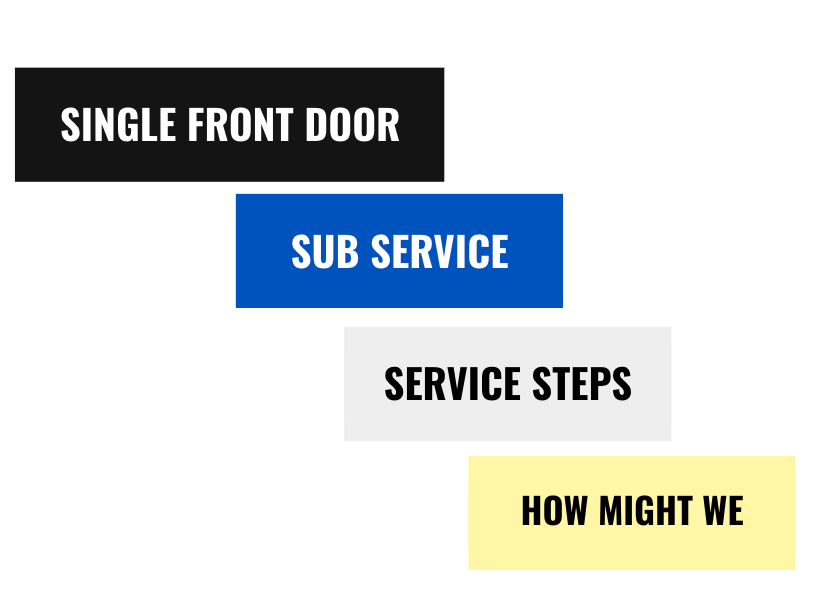
This graphic shows how the evidence from the research maps to the stages of service design.Ģż
Service design stages:Ģż
- Single Front DoorĢż
- Sub Service
- Service Steps
- How Might We
Service steps, needs and ā€˜how might we?ā€™ questions
The next few pages cover some of the steps, needs and ā€˜how might we?ā€™ questions which can be used as tools to help build the single front door against identified building blocks to meet user needs.
3 fundamentals for the single front door (informed by founders from the creative industries):
-
Discover finance options: Founders need to become aware by accessing relevant and timely information to begin, continue or grow new or existing knowledge.
-
Understand finance: Founders need the knowledge and ability to act or make a decision. Founders need to understand how something works and manage their expectations. For this they need to see options available and check if they are eligible.
-
Access (apply for) finance: Creative businesses need access to specific information, people or organisations to help them navigate the process of accessing or applying for finance. This could be through guidance, data or an online service, system or a tool.
1. Discover finance options
Founders need to become aware by accessing relevant and timely information to begin, continue or grow new or existing knowledge.
Find relevant information
Founders need to find out about relevant options via information and guidance.
Single front door considerations:
- How might we organise and share existing information to be relevant for sub-sectors?
- How might we explore and implement common standards and clear criteria across the whole of the finance ecosystem?
- How might we create a ā€˜trusted advisorā€™ equivalent via the single front door?
- How might we match-make creative founders with investors with shared values and principles?
Access/request to explore scenarios
Founders can access or request support from trusted sources with knowledge to explore legal and financial implications.
Single front door considerations:
- How might we find and build confidence in credible investors?
- How might we clearly highlight complex clauses to help founders understand the full impact/consequences?
- How might we show models and options to use a range of finance products?
- How might we give founders templates/ models/structures to adopt?
- How might we provide flexible and structured learning pathways (or support)?
Get support
Helps a founder unblock a problem. It could be related to a task or a process.
Single front door considerations:
- How might we build expertise in business support for creative industries?
- How might we give tailored advice to understand the specifics?
- How might we connect relevant and useful people together?
- How might we give structured learning which is flexible and accessible?
2. Understand finance
Founders need the knowledge and ability to act or make a decision. Founders need to understand how something works and manage their expectations. For this they need to see options available and check if they are eligible.
Check eligibility
Founders can see specific information or data they need to make a decision (Published eligibility guidance).
Single front door considerations:
- How might we encourage all financers to share their eligibility criteria in a format thatā€™s easy to understand and follow?
- How might we find ways to help founders identify whatā€™s available to them against their own profile?
Understand the process
This step helps founders understand the approval process to access finance (Mapping the end to end lifecycle, Standardise outcomes and metric definition).
Single front door considerations:
- How might we help founders clearly see the end-to-end process of applying for finance?
- How might founders assess if the funding options align to their mission?
- How might finance providers help founders estimate the time/effort required to complete an application against success criteria?
- How might we simplify grant applications to make them more accessible and reduce the admin burden?
Check my needs against whatā€™s available
Founders need to see specific information or data to make a decision against their business vision and needs (draft theory of change options).
Single front door considerations:
- How might we develop financial strategy simulators so that businesses can assess the impact and consequences of different finance options?
- How might we help businesses to understand and assess the impact and consequences of each funding option?
- How might we help businesses forecast their long term strategy to secure funding/finance for the short, medium and long term?
3. Access (apply for) finance
Creative businesses need access to specific information, people or organisations to help them navigate the process of accessing or applying for finance. This could be through guidance, data or an online service, system or a tool.
Pre-check
- Pre-check provides creative businesses with data points to help them determine their suitability to apply (establish where and how the data is configured, configure consistency or criteria across the system).
Single front door considerations:
- How might we enable creative businesses to self-review and decide to start or stop a process based on clarity provided by finance providers across the system?
- How might we identify best practice from those who already do this and make it available for those who are new to it?
- How might we explore best practice doā€™s and donā€™t to create a standard for consistency across the whole ecosystem?
Speaking the language
- Tools and templates give guidance and training to prepare or complete the process needed.
Single front door considerations:
- How might we bridge the language gap between creative industries and finance?
- How might tools provide in-the-moment support to translate and help founders meet the needs of investors while staying authentic to their business mission?
- How might we give founders purpose/mission-led frameworks to help pitch/tell a story that appeals to investors and aligns with their needs?
Apply/pitch
- Access to the system or space required to successfully complete the application or pitch.
Single front door considerations:
- How might we track the number of creative businesses pitching or applying across the system?
- How might we measure the success and failure rates?
Outcome with feedback
- Receive useful data as feedback to support business growth.
Single front door considerations:
- How might we understand the types of reasons founders fail/succeed?
- How might we encourage finance providers to invest time in creating a feedback loop that will ultimately improve the quality of the bids coming in to the funding and investment pipeline?