Epidemic intelligence activities
Updated 8 May 2026

漏 Crown copyright 2026
This publication is licensed under the terms of the Open Government Licence v3.0 except where otherwise stated. To view this licence, visit or write to the Information Policy Team, The National Archives, Kew, London TW9 4DU, or email: psi@nationalarchives.gov.uk.
Where we have identified any third party copyright information you will need to obtain permission from the copyright holders concerned.
This publication is available at /government/publications/emerging-infections-and-zoonoses-epidemic-intelligence-scanning-procedures/epidemic-intelligence-scanning-process
Epidemic intelligence activities
The UK Health Security Agency (UKHSA)鈥檚 Emerging Infections and Zoonoses (EIZ) team gathers information about outbreaks and incidents of new and emerging infectious diseases through their Epidemic Intelligence (EI) process. Timely detection of public health threats is critical to UKHSA鈥檚 and the UK government鈥檚 responses to threats that may affect the UK public, as well as raising awareness of incidents occurring globally.
The EI process is comprised of 3 distinct steps:
- Detection
- Assessment
- Communication
1. Detection
EI processes are undertaken each weekday by specialised scientists in the EIZ team. Signals are predominantly detected using the World Health Organization鈥檚 (WHO) (EIOS) platform. The EIOS platform collates thousands of articles daily from a broad range of publicly available sources including media, government and ministry of health websites and news aggregators.
As articles are imported into the platform, they are automatically translated and categorised into disease topic areas. The way EIOS organises the articles, which are continuously imported into the platform, enables the EIZ team to process a large amount of information each day. In addition, the EIZ team scan approximately 50 sources outside of the EIOS platform, to maximise signal detection coverage.
The aim of the EI process is to identify any new or updated information about outbreaks and incidents involving emerging infectious diseases which might pose a threat to the UK population. Epidemiological data on other outbreaks of public health significance is also gathered for situational awareness about incidents occurring globally.
Relevant events include:
- the identification of a new or emerging infectious agent
- undiagnosed morbidity or mortality events with a potentially infectious disease aetiology
- a new incident of epidemic potential either internationally or in a UK context
- identification of a new aetiological agent of a known disease or syndrome
- zoonotic or possible zoonotic outbreaks
- new or updated national or international infectious disease guidance
- bioterrorism incidents or potential deliberate release of biological agents
- scientific journal articles and pre-prints about new and/or emerging infectious diseases
The information sources included are regularly reviewed and updated in line with specific incidents being monitored. For example, local media sources may be checked for updates relating to outbreaks occurring in a specific geographical area. Where possible, official sources of information are sought to verify signals.
All relevant information is recorded in a dedicated EI database, which includes details on the date and source of the report, a description of the incident, its geographical location, and an EI confidence rating (which depends on the source of the information). Subsequent reports with any new information are also recorded.
2. Assessment
The public health significance of newly detected incidents is determined using criteria including:
- is the event unusual or unexpected?
- are there unexpectedly high rates of illness or death?
- is it likely to have a serious health impact?
- is there a potential for spread beyond national borders?
- is there a potential for interference with international travel or trade?
- is there local or national capacity to contain the outbreak?
- is the incident suspected to be due to deliberate release?
Incidents which do not meet one or more of the above criteria may still be monitored for situational awareness.
Reports of undiagnosed morbidity or mortality events are also identified during EI activities. Due to delays in confirmatory laboratory diagnostics, disease outbreaks may initially be reported as undiagnosed morbidity and mortality events where an infectious agent is suspected but the aetiology is unknown at the time of the initial report.
Previous outbreaks of major public health significance (including COVID-19, Ebola virus disease in West Africa, and Zika virus in the Americas) have been reported in the early stages as undiagnosed morbidity or mortality events. This highlights the importance of monitoring and detecting early reports of disease outbreaks. Reports of such events are logged, assessed, and closely monitored. Events that may be of greater concern are escalated appropriately within UKHSA and to the UK government.
2.1聽Risk assessments
The EIZ team produce assessments to determine the risk an outbreak of a disease poses to the UK public, UK interests overseas, and other populations. Risk assessments are disseminated within聽UKHSA, across the UK government, and to the UK devolved administrations. Recipients may use the risk assessments to inform public health action and support timely decision-making.
Probability and impact assessments, in addition to expert opinion, are used to inform the risk assessments. The probability of introduction of a pathogen into the UK population depends on the availability of routes of introduction into the UK, the likelihood of exposure, population susceptibility, and transmission mechanisms.
Table 1. Estimating probability
| Probability estimate | Criteria |
|---|---|
| Negligible | - no routes of introduction into the UK |
| Very low | - there are limited routes of introduction into the UK but - human exposure to the pathogen is unlikely |
| Low | - there are routes of introduction into the UK but - the UK population is not highly susceptible to pathogen聽 |
| Medium | - there are routes of introduction into the UK - the UK population is highly susceptible to the pathogen but - sustained transmission of the pathogen is unlikely |
| High | - there are routes of introduction into the UK - the UK population is highly susceptible to the pathogen - sustained transmission of the pathogen is likely |
The impact of an infection depends on the severity of disease in the population, the number of people affected, and the availability of interventions (for example, available treatments or control measures).
Table 2. Estimating impact
| Impact estimate | Criteria |
|---|---|
| Very low | - moderate to severe disease among cases in the affected UK population is unlikely |
| Low | - moderate to severe disease among cases in the affected UK population is possible but - it is unlikely a significant number of people will be affected |
| Medium | - moderate to severe disease among cases in the affected UK population is possible - it is likely a significant number of people will be affected but - there are effective treatments and control measures available |
| High | - moderate to severe disease among cases in the affected UK population is possible - it is likely a significant number of people will be affected - effective treatments and control measures are not available |
When probability and impact assessments have been completed, these can be combined to determine the overall risk level to the population in question, using the risk matrix below (Figure 1).
Expert opinion is applied to contextualise risk ratings, taking into account additional factors that may influence overall risk and further differentiate between categories.
Figure 1. Probability versus impact risk matrix
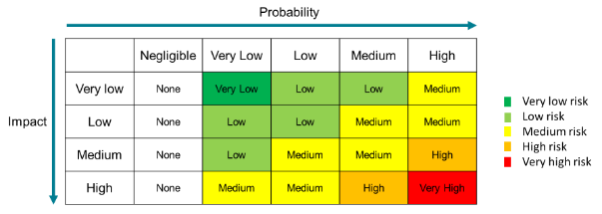
If you need an accessible version of Figure 1, contact EpiIntel@ukhsa.gov.uk
The EIZ team may conduct a rapid risk assessment of an overseas outbreak during the very early stages of an outbreak. In an evolving outbreak, information may be limited or subject to change, and so a confidence level is provided to acknowledge uncertainty and assist in interpretation. Risk assessments may be reviewed and updated as new information becomes available during an outbreak.
3. Communication and outputs
Information gathered through EI informs various routine and reactive outputs. If an incident is deemed to be of public health importance, it is reported to relevant groups and individuals both within聽UKHSA聽and across the UK government, as required depending on the risk identified. The EIZ team also share and receive EI from their international networks.
Uses of information gathered are outlined below.
3.1聽Guidance and incident response
EI gathered by the EIZ team is used to inform relevant public health guidance and maintain up to date disease specific webpages on gov.uk (for example, the Ebola clinical management and guidance collection).
EI is also used for international situational awareness during UKHSA鈥檚 responses to outbreaks, for example the multi-country monkeypox outbreak in 2022.
3.2听搁别辫辞谤迟蝉
The outbreaks under monitoring reports provide summaries of disease events monitored through UKHSA鈥檚 epidemic intelligence activities, including the location, reporting date, brief epidemiological overviews and links to relevant聽UKHSA聽guidance and information pages.聽The report is intended for healthcare professionals involved in the identification and management of suspected high consequence infectious diseases cases, as well as those with a broader interest in emerging infectious diseases and associated global incidents and outbreaks.
3.3聽Informal communications
Information is informally communicated with colleagues within UKHSA and from other UK government departments on request, and reports on particular international incidents are produced as required.