The Single Data List: a guide
Updated 8 May 2026
Applies to England

© Crown copyright 2026
This publication is licensed under the terms of the Open Government Licence v3.0 except where otherwise stated. To view this licence, visit or write to the Information Policy Team, The National Archives, Kew, London TW9 4DU, or email: psi@nationalarchives.gov.uk.
Where we have identified any third party copyright information you will need to obtain permission from the copyright holders concerned.
This publication is available at /government/publications/single-data-list/the-single-data-list-a-guide
Introduction
This page sets out the purpose and principles of the Single Data List (SDL). It is primarily designed for central government departments and their arm’s-length bodies that intend to collect data from local authorities.
It provides a step-by-step guide to the process for adding new data collections or amending existing ones on to the SDL.
The Single Data List
The Single Data List (SDL) is a list of all the datasets that local government must submit to central government. It aims to create transparency, eliminate duplication, and minimise data reporting burdens on local government. The SDL is not a database of the data collected, nor a list of the publications which draw on the data collected.
Central government requests for local authorities to collect and report data need to beÌýon theÌýSingle Data List.ÌýA list of exemptions is below.
If the dataset is not on the list, local authorities are not obliged toÌýprovide the requested data.
If it’s a new burden, central government needs to ensure local government is funded for this burden through the New Burdens Doctrine.
New datasets, or changes to the SDL must be jointly agreed by the Ministry of Housing, Communities and Local Government (MHCLG) and the Local Government Association (LGA) via the SDL process, ending in sign-off from the SDL Gateway Group.
The SDL Gateway GroupÌýrequiresÌýthe advice ofÌýmore specialist local authority groups, such as theÌýCentral Local Information Partnerships (CLIP)Ìýsub-groups, who understand the relevant dataÌýcollection.Ìý
The SDL is reviewed and updated annually.
Annex A provides details about government data collection.
Annex B gives details about the CLIP ²õ³Ü²ú-²µ°ù´Ç³Ü±è²õ.Ìý
Which data requests need to go through the SDL process?
Any data request by central government of local government needs to be approved through theÌýSDLÌýprocess.ÌýThere must be clear and strong rationale with only essential amounts of data collected that will be used.
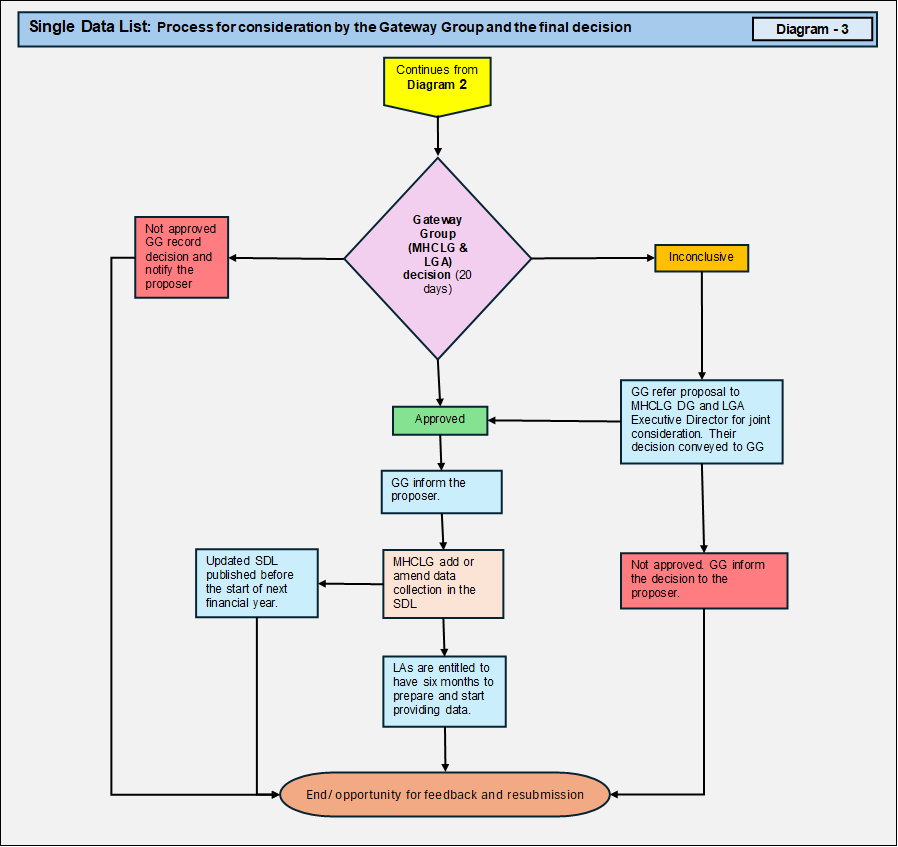
Local government should be given 6 months’ notice prior to the changes being implemented.
Central government may reasonably require data from local government for the following reasons (known as the ‘six key principles’) only:
Six principles:
-
To fulfil international obligations.
-
To support the effective administration of funding. Clarity is important in highlighting where data are being used as proxies (for example, free school meals being used as a proxy for need).
-
To support accountability to Parliament for national public funds and national policy decisions.
-
To hold public services to account, at a national level – holding government to account for national delivery.
-
To support the evaluation of economic, social, and environmental trends, in the national interest.
-
To provide comparable local performance data, by exception, where it doesn’t already exist, to support local accountability by citizens.
Data requests exempt from theÌýSDLÌýprocess are:Ìý
-
Voluntary data returns: Local government can decide whether they wish to participate. It should be explicitly stated that their participation is voluntary. The Gateway Group suggests this text: “This data collection is not part of the Single Data List, and so completion is voluntary. Councils are encouraged to participate to ensure data robustness, but it is up to each Council to decide.�
-
Grant/programme data: Data required when applying for or participating in a specific grant, project, or programme. In this case, it is expected that the grant amount or project funding includes the reporting cost.
-
Non-councilÌýrole related returns: Returns not directly related to councils’ role e.g. as an employer. (For these exclusions, the data provision requirement will be specified by the relevant body elsewhere as appropriate.)
-
Ad hoc requests: Data required in exceptional circumstances as a one-off.
-
Locally published data: Data required to be published locally for accountability but not submitted to central government. This will still need a new burdens funding assessment and would benefit from discussion with the CLIP subgroups to ensure data quality and comparability.
If central government departments are unsure about whether a data request is exempt or not, please emailÌýSingleDataList@communities.gov.ukÌýfor advice.
This guidance is aimed at central government departments (and their arms-length bodies) who intend to add collections or make changes to data collections to the SDL.
Summary of the SDL process
Local authority feedback: Consult Central Local Information Partnership (CLIP) sub-group and local authorities
Complete forms:
- complete New Burdens Assessment
- complete Gateway group top-sheet
Decision: Submit forms to MHCLG-LGA Gateway group
See a more detailed step-by-step diagram of the process below.
SDL process in detail
Please read accompanying notes below.
Diagram 1: Process for new proposals and amending existing data collections
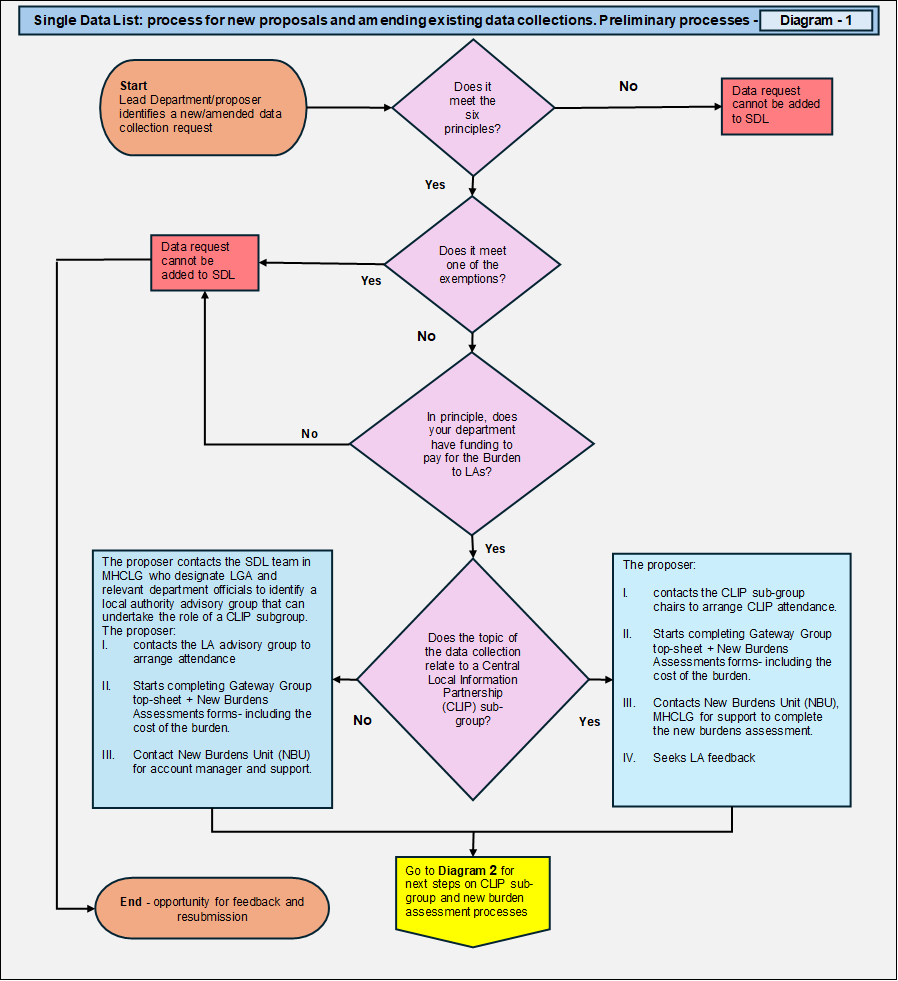
Diagram 2: Process for consideration by the CLIP sub-group and assessment of new burdens
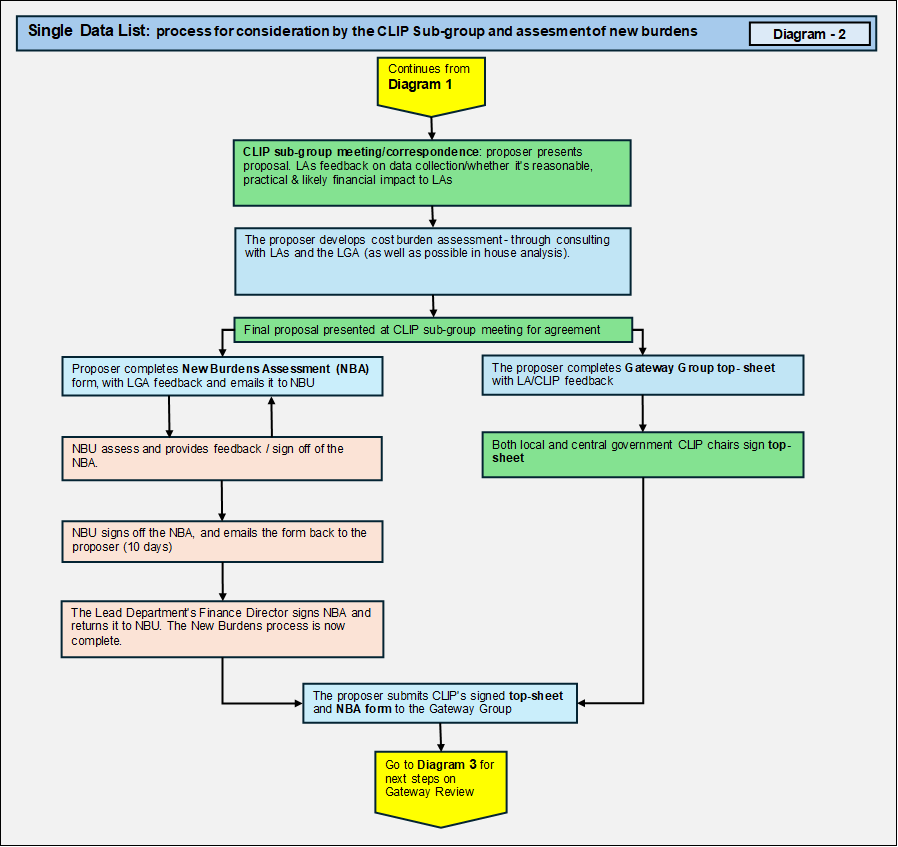
Diagram 3: Process for consideration by the Gateway Group and the final decision
Step-by-step process
Pre-process checks - consider whether your data request is necessary
- Check your request meets at least one of the six principles.
- Check whether it meets one of the exemptions listed above.
- Check that in principle, your department has funding to pay for the burden to local authorities.
- Check the following:
- Does the data (or similar) already exist?
- Could a smaller sample or specific research project provide the information?
- Is the collection only as often as needed?
- Could collection be voluntary, rather than mandating through theÌýSDL?
- Are you collecting only the items you require? Or does it include ‘nice to know’ items?
- Do the benefits of the data to users outweigh the costs to data providers?
Step 1: Contact CLIP, New Burdens Unit and start completing forms
i) The relevant Central Local Information Partnership (CLIP) sub-group chairs
°Õ³ó±ðÌýCLIP subgroupsÌýbrings together data suppliers, compilers, and users on specific subject areas to challenge and assess data requirements.
Contact the relevant CLIP sub-group chairs to discuss data collection and attend a meeting - in updating the CLIP you should cover: what the data is/relates to, rationale behind data collection and confirm that it does not already exist.
If there is no appropriate CLIP sub-group another local authority group will be set up. Please contactÌýsingledatalist@communities.gov.uk.
ii) Start completing the Gateway Group top sheet and New Burdens Funding assessment form.
iii) Contact the New Burdens Unit to warn them of upcoming assessment and for support:Ìýnewburdens@communities.gov.uk.
Step 2: Attend a CLIP sub-group and develop assessment with local authorities/LGA
Attend a CLIP meeting to seek early views on the issues, understand the burdens and make necessary adjustments to your data collection.
This is to ensure that the proposed data collection is necessary and if so, is fit for purpose.
As part of their challenge, CLIP sub-groups may consider:
- Existing data evaluation: Has there been an assessment of existing data sources before starting a new collection?
- Justifiable data items: Has the collection been padded with nice-to-know information?
- Sampling approach: Can a sampling approach be adopted instead of complete coverage?
- Supplier discussions: Have discussions occurred with administrative system suppliers for central changes?
- Review programme: Is there a rolling programme to review existing returns over a certain period?
Step 3: Present final proposal to CLIP
Having discussed the new or amended collection with the CLIP sub-group, youÌýshould present your final plans for the data collection to them,Ìýincluding any new burdens assessment,Ìýand seek theirÌýfinalÌýviewsÌý and whether theyÌýwill recommend its acceptanceÌýtoÌýthe SDL Gateway Group.Ìý
Ìý
Step 4: Complete New Burdens Assessment and Gateway Group top sheet
Following yourÌýlastÌýpresentationÌýto the CLIP sub-group, you shouldÌýfinalise theÌýNew Burdens AssessmentÌýformÌýdetailing how youÌýhave calculated any new burden and, if there is one,Ìýwhether you have arrangements in place to cover those costs to local authorities.ÌýÌý
In addition,Ìýyou shouldÌýcompleteÌýtheÌýGateway Group top sheet with a summary of the discussionÌýyou had with the CLIP sub-group, and any recommendation for the SDL Gateway GroupÌý(for example, to accept the new data collection or not).ÌýYou should reflect the CLIPÌýsub-group’s/local authorityÌýfeedback.ÌýThe local authority joint chair of the CLIP sub-group shouldÌýagree the top sheet isÌýan accurateÌýreflection of the discussion and recommendation.Ìý
The detail of the New Burdens Assessment does not need to be included in the Gateway Group top sheet.ÌýYouÌýcan cross-referenceÌýthe former in the GatewayÌýGroup top sheet.Ìý
Step 5: Submit New Burdens Assessment to the New Burdens Unit, MHCLG
Send this to newburdens@communities.gov.uk. You may receive feedback from the New Burdens Unit which you will need to reflect in updating the assessment.
Step 6: Finalise New Burdens Assessment and seek finance approval
Once agreed,ÌýtheÌýNew Burdens UnitÌýwill authorise the new/amended data collection.
You will then need to seek your Department’s financeÌýdirector’s approval team.
This allows payment to local authoritiesÌýshould theÌýdata collection be accepted onto the Single Data List.Ìý
Only when the proposal is accepted by the CLIP subgroup and the funding position agreed, should you progress to the next step.
Step 7: SubmitÌýforms to the SDLÌýGatewayÌýGroupÌý
Submit the CLIP sub-group approved Gateway Group top sheet and signed New Burdens Assessment to SingleDataList@communities.gov.uk for the Gateway Group. Failure to provide either of these will delay the Gateway Group decision.
The Gateway Group members are officials from MHCLG, local authorities and the LGA. Both organisations also provide secretarial support.
The Gateway Group is accountable to the Director General (Local Government), MHCLG and the Director of Data, Insights and Innovation, Local Government Association.
°Õ³ó±ðÌýGroupÌýgoverns the process of adopting changes to the SDL, ensuring new data requirements are necessary, fully funded, minimalise burdens, and meet at least one of the six data principles.
Please allow 20 working days for the Group to review the submission.Ìý
In the rare occurrence that the Gateway Group cannot decide on a new data requirement, the case can be referred to the MHCLG Director General and the Executive Director.
The decision will be conveyed to you and CLIP Subgroup.
Once approved, the data collection or changes will be included in the Single Data List published in March for data to be collected in the financial year starting in the April.
Once collected, data should be published as quickly as possible. If data is important enough to be required from local government, central government should allocate enough resources to process the data in a reasonable time.
The Gateway Group may consider the proposal for adding or changing data aligns with these principles:
- Burden size: Is the new burden funding sufficient to cover it?
- Consultation breadth: Does the new burdens form show appropriate consultation with local authorities?
- Data meaningfulness: Are the collected data useful both centrally and locally?
- Local usefulness: If not useful locally, central government must strongly justify its importance.
- Crucial or nice-to-know: If it’s not demonstrably crucial, it’s presumed that it cannot be justified.
- Mandatory collection: Why must the information be collected mandatorily instead of voluntarily?
- Effective challenge: Is there evidence of an effective challenge through the CLIP sub-group process?
These principles apply equally when local government report data to non-central government bodies at the request of the central government.
Further information
Analytical Heads of Profession Office, MHCLG
Email: SingleDataList@communities.gov.uk
Data, Insight and Innovation, LGA
Phone: 020 7664 3000
Email:Ìýdata@local.gov.uk
Annex A: Government data collection
Public sector data is a valuable asset necessary for effective service management and to inform accountability structures. It can empower citizens by helping them make informed choices and hold service providers to account. However, the process of data collection, analysis, and publication can be burdensome.
The government’s policy is to minimise the data reporting burdens on councils, reflecting the accountability landscape and the financial pressures facing councils. The principles that should underpin decisions on the appropriateness of mandatory data collections are set out above.
The rationale for any data collection must be transparent and only the minimum amount of data should be collected to meet that requirement.
°Õ³ó±ðÌýMHCLGÌýPermanent Secretary is required to provide assurance to Parliament that a core accountability system is in place for local government. Accessible and comparable local performance data is a key part of this system; allowing the public to hold authorities to account more effectively.
Where councils are under a national statutory duty to provide data, they must continue to do so. However, in assessing the reasonableness of a data requirement, central government should not consider the presence of a statutory duty to be a justification for continued collection.
The government has a role in ensuring openness and transparency of public data more broadly. Freedom of Information gives people the right to ask for information held by a public body on any subject. The principles of data collection and publication should apply to the whole public sector. This means the central government should be as transparent as local authorities when publishing data.
Annex B: Joint chairs of the CLIP sub-groups
Adult Social Care - Data Outcomes Board
- Central Government Chair: Uma Moorthy (Department of Health and Social Care) Uma.Moorthy@dhsc.gov.uk
- Local Government Chair: Dave Watts (North Northamptonshire) David.Watts@northnorthants.gov.uk
- Secretariat: Nic Duffy-McCormack (Department of Health and Social Care) Nic.Duffy-Mccormack@dhsc.gov.uk
Census
- Central Government Chair: Lara Phelan (Office for National Statistics (ONS)) Lara.Phelan@ons.gov.uk
- Local Government Chair: None
Education and Children’s Social Care – DfE Star Chamber
- Central Government Chair: Paul Hirst (Department for Education) and Jamie James (Department for Education) starchamber.mailbox@education.gov.uk
- Local Government Chair: Rashid Jussa (London Councils) Rashid.Jussa@londoncouncils.gov.uk
Environment
- Central Government Chair: John Joseph (Department for Environment Food and Rural Affairs) (Interim) John.Joseph@defra.gov.uk
- Local Government Chair: Niamh Skelly (Local Government Association) Niamh.Skelly@local.gov.uk
Finance
- Central Government Chair: Abi Shaw (MHCLG) Abigail.Shaw@communities.gov.uk
- Local Government Chair: Luke Masters (LGA) Luke.Masters1@local.gov.uk
Fire
- Central Government Chair: Amy Cornwall Amy.Cornwall@communities.gov.uk
- Local Government Chair: Steve Taylor Steve.Taylor@nfcc.or.guk
Housing
- Central Government Chair: Miguel Marques dos Santos (MHCLG) Miguel.MarquesdosSantos@communities.gov.uk
- Local Government Chair: Lee Anne Hill (Broxbourne Borough Council) LeeAnne.Hill@broxbourne.gov.uk
- Secretariat: Alistair Rice (MHCLG) Alistair.Rice@communities.gov.uk Taiwo Ologunowa (MHCLG) Taiwo.Ologunowa@communities.gov.uk
Labour market
- Central Government Chair: Myrto Miltiadou (ONS) Myrto.Miltiadou@ons.gov.uk
- Local Government Chair: Gareth Henry (Hampshire Council) Gareth.Henry@hants.gov.uk
Planning
- Central Government Chair: Andrew Presland (MHCLG) Andrew.Presland@communities.gov.uk
- Local Government Chair: David Dale (Derbyshire County Council) David.Dale@derbyshire.gov.uk
Population
- Central Government Chair: Rich Pereira (ONS) Richard.Pereira@ons.gov.uk
- Local Government Chair: Eddie Holmes (Luton Borough Council) Edward.Holmes@luton.gov.uk
Transport
- Central Government Chair: Benjamin Rees (Department for Transport) Benjamin.Rees@dft.gov.uk
- Local Government Chair: William Bryans (Surrey County Council) William.Bryans@surreycc.gov.uk
- Secretariat: Paul Syron Paul.Syron@dft.gov.uk