Non-domestic rating: challenges and changes background information
Published 6 August 2026
Applies to England and Wales

Ā© Crown copyright 2026
This publication is licensed under the terms of the Open Government Licence v3.0 except where otherwise stated. To view this licence, visit or write to the Information Policy Team, The National Archives, Kew, London TW9 4DU, or email: psi@nationalarchives.gov.uk.
Where we have identified any third party copyright information you will need to obtain permission from the copyright holders concerned.
This publication is available at /government/statistics/non-domestic-rating-challenges-and-changes-2023-and-2026-rating-lists-june-2026/non-domestic-rating-challenges-and-changes-background-information
1. Valuation OfficeĀ AgencyĀ mergerĀ
From 1 April 2026, the Valuation OfficeĀ AgencyĀ (VOA) merged with HM Revenue & Customs (HMRC). Most functions of theĀ VOAĀ have now been absorbed by the Valuation Office (VO) group within HMRC. Throughout the documents associated with these statistics,Ā referenceĀ will be made to the work carried out byĀ VO, but some documents will stillĀ make referenceĀ to theĀ VOA. This will particularly be the case when referring to documentsĀ pertaining toĀ official statistics previously published by theĀ VOA.Ģż
1.1 Scope and content of the dataĀ
This releaseĀ containsĀ statistics relating to challenges and changes for England and Wales across both theĀ 2023Ā rating list and theĀ 2026Ā rating list which came into effect on 1 AprilĀ 2026. This release includes statistics on Checks and Challenges forĀ England andĀ Wales under the Check, Challenge, Appeal (CCA) process. Further information is provided below, and more information on the CCA system can be found in the CCA ²õ±š³¦³Ł¾±“Ē²Ō.Ģż
°Õ³ó±šĢżVOĀ no longerĀ reportĀ on the 2010 local rating list as all cases have now been resolved. The 2017 list closed on 31 March 2023. This publication reports onlyĀ the numberĀ ofĀ outstandingĀ challengesĀ against the 2017 rating lists.Ģż
1.2 Checks, Challenges and ChangesĀ against the 2026Ā local rating list for England and WalesĀ
This publication includes Checks and Challenges made under the CCA processĀ against the 2026Ā rating list in England and Wales from April 2026.Ģż
Statistics related to cases raised under the CCA process (for the 2026Ā rating list), including:Ā
-
Table EW26_1_1: Summary of Checks and Challenges since start of rating listĀ
-
Table EW26_1_2: Outcome of resolved Checks and Challenges since start of rating listĀ
-
Tables EW26_2_1 to EW26_2_2: Checks and Challenges by administrative area since start of rating listĀ
-
Tables EW26_3_1 to EW26_3_2: Quarterly and monthly time series of Checks and Challenges, EnglandĀ
-
Tables EW26_3_3 to EW26_3_4: Quarterly and monthly time series of Checks and Challenges, WalesĀ
-
Tables EW26_4_1 to EW26_4_4: Resolved CCA cases by party representation and change inĀ rateableĀ valueĀ
-
Table EW26_4_5: Resolved CCA cases by financial quarter and change inĀ rateableĀ value, EnglandĀ
-
Table EW26_4_6: Resolved CCA cases by financial quarter and change inĀ rateableĀ value, WalesĀ
1.3Ā Checks, Challenges and ChangesĀ against the 2023 local rating list for England and WalesĀ
This publication includes Checks and Challenges made under the CCA processĀ against the 2023 rating list in England and Wales from April 2023.Ģż
Statistics related to cases raised under the CCA process (for the 2023 rating list), including:Ā
-
Table EW23_1_1: Summary of Checks and Challenges since start of rating listĀ
-
Table EW23_1_2: Outcome of resolved Checks and Challenges since start of rating listĀ
-
Tables EW23_2_1 to EW23_2_2: Checks and Challenges by administrative area since start of rating listĀ
-
Tables EW23_3_1 to EW23_3_2: Quarterly and monthly time series of Checks and Challenges, EnglandĀ
-
Tables EW23_3_3 to EW23_3_4: Quarterly and monthly time series of Checks and Challenges, WalesĀ
-
Tables EW23_4_1 to EW23_4_4: Resolved CCA cases by party representation and change inĀ rateableĀ valueĀ
-
Table EW23_4_5: Resolved CCA cases by financial quarter and change inĀ rateableĀ value, EnglandĀ
-
Table EW23_4_6: Resolved CCA cases by financial quarter and change inĀ rateableĀ value, WalesĀ
1.4Ā ChallengesĀ against the 2017 local rating list for EnglandĀ
This publication also reports the number of outstandingĀ Challenges made from April 2017Ā against the 2017 local rating list in England.Ģż
1.5Ā ChallengesĀ against the 2017 local rating list for WalesĀ
In Wales, challengesĀ against the 2017 local rating list are handled using the non-CCA process (see below for more details). This publicationĀ reportsĀ the number of outstanding challengesĀ against theĀ 2017 local rating list for Wales.Ģż
1.6Ā Differences between CCA Statistics and Non-CCA ³§³Ł²¹³Ł¾±²õ³Ł¾±³¦²õĢż
The statistics in this publication can be broadly grouped into two types, CCA-process related statistics (2026 and 2023 rating listsĀ Checks and Challenges in England and Wales and 2017 rating list Checks and Challenges in England) and non-CCA-process related statistics (statistics on challenges and reviewsĀ against the 2017 rating list for Wales). It is important to understand the differences between the two sets of statistics.Ģż
1.7Ā Definition of a challengeĀ
A challenge has a different and specific meaning when used in the CCA process as opposed to when used under the non-CCA ±č°ł“Ē³¦±š²õ²õ:Ģż
-
CCA process ā€“ a Challenge to a valuation is made only after the completion of a CheckĀ
-
Non-CCA process ā€“ a challenge can be either a proposal to change a valuation or aĀ subsequentĀ appealĀ against a valuationĀ
This is covered in more detail in the Glossary.Ģż
1.8Ā Registered and receivedĀ
CCA Check and Challenge statistics show the number of Checks and Challenges registered by theĀ VOĀ while non-CCA challenge statistics show numbers of cases received by theĀ VOĀ asĀ at a point in time. When information is received by theĀ VOĀ manuallyĀ it is marked with a ā€˜receivedā€™ date. The information is then registered on theĀ VOĀ administrative system at which point a ā€˜receivedā€™ and ā€˜registeredā€™ dateĀ areĀ recorded.Ģż
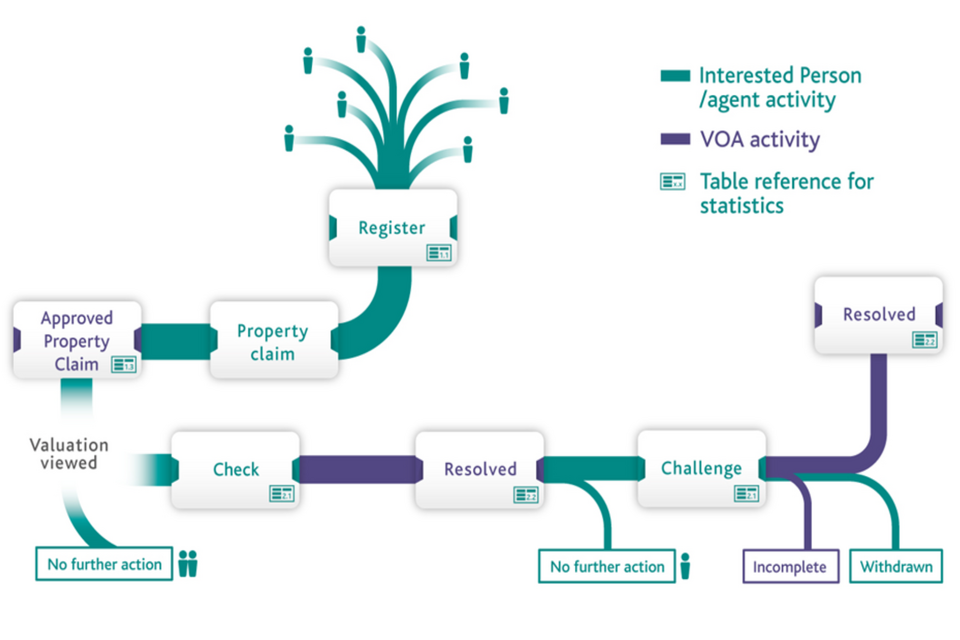
2. Check, Challenge, AppealĀ
The business rates appeal process in England from 1 April 2017 is known as Check, Challenge, Appeal (CCA). Wales adopted the CCA process on 1 April 2023. °Õ³ó±šĢżVOĀ deals with Checks and Challenges, while the independent Valuation Tribunal Service(VTS) and Valuation Tribunal for Wales (VTW) handle Appeals. Business rates appeals are handled differently inĀ Ģż²¹²Ō»åĢż.Ģż
Owners, occupiers, andĀ authorisedĀ agents must first register to use the online service and view or request details of their valuation.Ģż
There are three stages to the new process ā€“ ā€˜Checkā€™,Ā ā€˜Challengeā€™ and ā€˜Appealā€™:Ā
-
The Check stageĀ sets out exactly how a valuation has been calculated. It provides the Interested Person (IP) with all the underlying facts and allows them to update those facts if they have changed or are incorrect. This means that everyone understands andĀ agreesĀ the factual basis for any valuation, and that valuation can be amended at this stageĀ if necessary.Ģż
-
The Challenge stageĀ allows people to challenge the valuation if they feel the calculation done based on the factsĀ establishedĀ at Check is incorrect. IPs or theirĀ agents provideĀ the fullĀ evidence for their Challenge, giving theĀ VOĀ the opportunity to resolve the issue without the need for an Appeal. °Õ³ó±šĢżVOĀ are required toĀ presentĀ the fullĀ evidence to support their decision.Ģż
-
If IPs are not satisfied with theĀ VOā€™s decision, having understood all the evidence and basis for the decision, they can appeal to the independent VTS/VTW. This appeal is undertaken inĀ the fullĀ knowledge of all the evidence and arguments put forward from both sides at the ChallengeĀ stage.Ģż
Figure 1 provides an overview of the CCA process.Ģż
Figure 1: Overview of the CCA process
These statistics no longer report the number of registrations and property claims under the new CCA process. For England, the Valuation Tribunal Service publishĀ . Similarly for Wales, the Valuation Tribunal Wales publish . Further information about CCA can be foundĀ on °Ēøē³Ō¹Ļ.ĢżĀ
3. Technical NotesĀ
This release includes statistics on Challenges made by taxpayers (or their representatives)Ā against the 2026, 2023 and 2017 local rating lists. Previous quartersā€™ figures include retrospective changes so will not necessarily be the same as those fromĀ previousĀ publications.Ģż
Figures in the release note may be rounded to a different level of accuracy from the figures in the MS Excel tables and should therefore be considered more definitive.Ģż
The statistics are derived fromĀ VOā€™s administrative database and are published at national, regional, and billing authority level.Ģż
°Õ³ó±šĢżVOĀ isĀ required, by the Local Government Finance Act 1988, to compile andĀ maintainĀ accurateĀ rating lists specifying aĀ rateableĀ value for all non-domesticĀ rateableĀ properties in England and Wales. TheseĀ rateableĀ values provide the basis for national non-domesticĀ ratesĀ bills, which are issued by billing authorities. There is a local rating list for each billing authority. However, for simplicity, we have referred to these throughout this publication as one combined ā€˜rating listā€™ for those local lists effective from 1 April 2026, and, likewise, one combined ā€˜rating listā€™ for those local rating lists effective from 1 April 2023.Ģż
Ratepayers, owners, and in limited circumstances, relevant authorities, and other persons (known formally as Interested Persons) can make a Challenge to alter the rating list if they think an entry is incorrect. Challenges can also be made on behalf of interestedĀ personsĀ by their professional representatives.Ģż
4. Data QualityĀ
4.1 Suitable data sourcesĀ
The information supplied in the tables is based upon administrative data held within theĀ VOā€™s operational database. All administrative data are subject to processing and processĀ errorsĀ and as such, while theĀ VOĀ has made every effort to ensure accuracy of the data underpinning this publication, it is possible that some errorsĀ remain.Ģż
4.2 Assured qualityĀ
Our quality assurance follows the approach set out in theĀ VOAĀ Quality Policy.Ģż
As part of the production of this publication, quality assurance takes place:Ā
-
during the valuation of propertiesĀ
-
as part of the creation of the data which underpins the publicationĀ
-
as part of the coding which produces the publication outputsĀ
-
as part of automated and manual checks of outputsĀ
-
using a comprehensive QA Check List and a QA Issues LogĀ Ā
5. Use made of the dataĀ
This publication is being released as part of theĀ VOā€™s commitment towards making its data more accessible as well as continuing to improve, and make more consistent, presentation of information toĀ assistĀ users conducting their own analysis ofĀ VOĀ data. The dataĀ areĀ used to inform government policy and conduct analyses to support the operations of theĀ VO.Ģż
In a widerĀ contextĀ this publication supports BAsā€™ requirements for information in respect of the Business Rates Retention Scheme contained within theĀ .Ģż
We will keep underĀ reviewĀ the format of this summary document to improve the presentation of our statistics and welcome feedback from users on the usefulness of the information provided in this summary. PleaseĀ forwardĀ any comments to theĀ statisticsvo@hmrc.gov.uk.ĢżĀ Ā
6. CSV MetadataĀ
A file which provides the variable names and descriptions appearing in the CSV files is included in this release; it can be found within the ā€˜CSV Filesā€™ zip file on the release page.ĢżĀ
7. Timeliness and PunctualityĀ
Timeliness refers to the lapse of time between publication and the period to which the dataĀ refer. Punctuality refers to the gap between planned and actual publication dates.Ģż
Releases are always punctual and published onĀ the pre-announced dates. Pre-announcement of the precise date may occur up to four weeks before publication. We always pre-announce the month of publication in our 12-month planning schedule.Ģż
This publication is published on a quarterly basis within two months of the last day of the reference period.ĢżĀ
8. RelevanceĀ
Relevance is the degree to which statistical outputs meet usersā€™ needs.Ģż
It is important that the statistics produced are relevant to user needs and that they meet the needs of users, both in coverageĀ and in content. These statistics evolvedĀ largely inĀ response to Freedom of Information requests and Parliamentary Questions and were further developed with input fromĀ a NDRĀ Statistics Advisory Panel which consisted of key users of the data.ĢżĀ
9. Coherence and ComparabilityĀ
Coherence is the degree to which data that are derived fromĀ different sourcesĀ or methods, but refer to the same topic, are similar. Comparability is the degree to which data can be compared over time and domain, for example, geographic level.Ģż
These statistics are drawn from the same source and use a coherent and consistentĀ methodology.Ģż
CCA and non-CCA statistics cannot be compared as these statistics relate to different processes. For further information, please see the ā€˜Differences between CCA statistics and non-CCA statisticsā€™ section of this document.ĢżĀ
10. Accessibility and ClarityĀ
Accessibility is the ease with which users can access the data, also reflecting the format in which the dataĀ areĀ available and the availability of supporting information. Clarity refers to the quality and sufficiency of theĀ releaseĀ details andĀ accompanyingĀ advice.Ģż
The release is available free of charge. All official statistics are made available primarily as Excel spreadsheets with data available in an open format (CSV versions) and a background informationĀ document.ĢżĀ
11. Confidentiality, Transparency and SecurityĀ
Access to the data and release during its publication is limited to theĀ statisticsĀ production team only. Occasionally, valuation experts may be consulted as part of the quality assurance process. The list of pre-release recipients is published alongside the release.Ģż
Further information canĀ foundĀ within theĀ VOAĀ Confidentiality and Access policy.ĢżĀ
12. Further InformationĀ
Ā Timings of future releases are regularly placed on theĀ HMRC research and statistics calendar.Ģż
For further information on the area codes used in this release, please refer to theĀ .ĢżĀ
13.ĢżGlossaryĀ
Appeal (non-CCA process)Ā ā€“ an appeal consists of both Valuation Tribunal cases and Upper/Lands Tribunals cases. A challenge only becomes an appeal when the proposal (IPP) is referredĀ toĀ the Valuation Tribunal Service.Ģż
Appeal (CCA process)Ā ā€“ an Appeal in the Check,Ā Challenge,Ā Appeal process consists of an appeal referred by the IP to the Valuation Tribunal for an independent review.Ģż
Area codeĀ ā€“ a unique identifier for administrative geographies as specified by the Office for National Statistics (ONS).Ģż
AssessmentĀ ā€“ an entry in the rating list is often referred to as an assessment.Ģż
Assessment review (report)Ā ā€“ assessment reviews (reports) relate to instances where theĀ VOĀ will review the entry in the rating list. They can be either a reportĀ initiatedĀ by the BA, known as a Billing Authority Report, orĀ initiatedĀ by theĀ VO, known as a Valuation Office Report. These could typically be attributable to a demolition, new propertyĀ buildĀ or other physical change to a property. An assessment review (report) is counted as received when it has been registered onĀ theĀ VOā€™sĀ administrative system.Ģż
µž¾±±ō±ō¾±²Ō²µĢż²¹³Ü³Ł³ó“Ē°ł¾±³Ł²āĢż(BA)Ā ā€“ a local authority empowered to collect non-domestic rates on behalf of itself and other local authorities in its area. In England, shires, metropolitan districts, the Council of the Isles of Scilly, unitary authorities, LondonĀ boroughsĀ and the City of London are BAs.Ģż
Billing authority codeĀ ā€“ a unique identifier for BAs.Ģż
Billing authority report (BAR)Ā ā€“ a report (assessment review)Ā initiatedĀ by the BA. These could typically be attributable to a demolition, new propertyĀ buildĀ or other physical change to a property.Ģż
Cancelled challenge or assessment review (non-CCA process)Ā ā€“ a challenge/assessment review raisedĀ against a property in error that is cancelled.Ģż
Central rating listĀ ā€“ theĀ VOā€™s list ofĀ rateableĀ values for companies named in the Central Rating List Regulations, primarily for the network property of major transport, utility, and telecommunications undertakings and cross-country pipelines. There are separate lists for England and Wales.Ģż
Challenge (CCA process)Ā ā€“ the IP can challenge any valuation related to the same property within four months of the Check completion. IPs can also make a Challenge if theĀ VOĀ has not completed the Check after 12 months. If the ChallengeĀ is aboutĀ a change in the surrounding area (a material change of circumstances), then the Challenge can be made either within four months after the Check completion or within 16 months of the IPā€™s Check confirmation.Ģż
Challenge (non-CCA process)Ā ā€“ a proposal by the ratepayer to alter the 2017 rating list in Wales:Ā typicallyĀ attributable to a challenge to the assessedĀ rateableĀ value or a change of circumstance of the property as well as physical changes in the locality. Challenges consist of both IPPs and appeals. IPPs are commonly, though incorrectly, referred to as appeals; technically a challenge only becomes an appeal when the proposal is referred to the Valuation Tribunal Service. A challenge is counted as being received when it has been registered on theĀ VOā€™s administrative system. It is counted as being resolved when it has beenĀ clearedĀ and the rating list has been updated.Ģż
Challenge outcomes (CCA process)Ā ā€“ resolved Challenges may be:Ā
-
Agreed ā€“ this category is made up of Challenges resolved with an outcome of well-founded orĀ agreement reached. Well-founded is an outcome where theĀ VOĀ agrees with the proposed alteration to the list and the date from which the proposed alteration should take effect.ĢżAgreement reached is an outcome where theĀ VOĀ and the IP come to anĀ agreement which is different to the proposed alteration of the list and/or the date from which the proposed alteration should take effect.Ģż
-
Disagreed ā€“ this category is made up of challenges resolved with a considered decision, which is where theĀ VOĀ and the IP cannotĀ agreeĀ the proposal, so theĀ VOĀ issues its decision that may or may not result in an alteration to the list.Ģż
Check (CCA process)Ā ā€“ a review by the IP of the information held by theĀ VOĀ for their property. The IP confirms the accuracy of the facts on which the rating list entry is based, provides missingĀ factual informationĀ and amends propertyĀ detailsĀ as necessary.Ģż
Check completionĀ ā€“ a resolved Check: theĀ VOĀ haveĀ responded to the IP,Ā statingĀ the outcome in full and cleared the case.Ģż
Check confirmationĀ ā€“ the point during Check at which the IP confirms the accuracy of the facts on which the rating list entry is based, provides missingĀ factual informationĀ and amends propertyĀ detailsĀ as necessary.Ģż
Check outcomesĀ ā€“ there are three outcomes for resolved Checks, which are:Ā
-
Agreed ā€“ theĀ VOĀ agrees with/accepts all the facts provided by the IP. This can include Checks that lead to no change to the facts proposed by the IP.Ģż
-
PartiallyĀ agreed ā€“ theĀ VOĀ agrees with/accepts some of the facts provided by the IP.Ģż
-
Disagreed ā€“ theĀ VOĀ does notĀ agree with/accept the facts provided by the IP.Ģż
Compiled listĀ ā€“ the rating list as it comes into effect following revaluation; for the 2017 rating list this is the list asĀ atĀ 1 April 2017 and for the 2023 rating list it is the list asĀ atĀ 1 April 2023. The 2026 rating list came into effect asĀ atĀ 1 April 2026.Ģż
DirectionĀ ā€“ the Tribunalā€™s written instructions that the appellant and theĀ VOĀ must follow.Ģż
Incomplete challengeĀ ā€“ the Challenge does notĀ containĀ all theĀ detailĀ requiredĀ in legislation and so is not accepted by theĀ VO.Ģż
InterestedĀ person (IP)Ā ā€“ an interested person can be an individual or a company who is the owner, occupier or ratepayer of the property, or a person with a ā€˜qualifying connectionā€™.ĢżA person has a qualifying connection if they own the company that owns the property, if they are a company owned by the property owner or occupier, or if both they and the property owner or occupier are companies owned by the same company.Ģż
Interested person proposal (IPP) (non-CCA process)Ā ā€“ a proposal by the IP orĀ agent acting on their behalf to alter the local rating list entry.Ģż
Invalid proposal (non-CCA process)Ā ā€“ a proposal that has beenĀ submittedĀ to theĀ VOĀ that theĀ VOĀ considers to be incorrect. In theseĀ circumstancesĀ theĀ VOĀ informs the maker of the proposal why they consider the proposal to be invalid. The maker of the proposal has theĀ optionĀ to appeal to the Valuation TribunalĀ against theĀ VOā€™s decision.Ģż
Lands Tribunal casesĀ ā€“ the functions of the Lands Tribunal were transferred to the Upper Tribunal (Lands Chamber) on 1 June 2009. These cases are now known as Upper Tribunal cases andĀ includesĀ any appeal to the Upper Tribunal (Lands Chamber), Court of Appeal and Supreme Court.Ģż
Local rating list(s)Ā ā€“ theĀ VOā€™s lists of all the non-domesticĀ rateableĀ properties in England and Wales. There is a separate local list for each BA.Ģż
Minor rating list change (MRL)Ā ā€“ a minor change to a rating list entry usually correcting a typographical error in the address or description of a property.Ģż
OutstandingĀ ā€“ a case is counted as being outstanding when it has been registered on theĀ VOā€™s administrative system and has not been resolved.Ģż
Property claimĀ ā€“ before anyone can access more detailed valuation data about a property, they must prove that they have a legal interest in the property under the non-domestic rating legislation, for example as an owner or occupier or both. To do this, theyĀ are required toĀ ā€˜claim their propertyā€™ throughĀ theĀ VOā€™sĀ online service and provide proof of their relationship to the property, such as a copy of a businessĀ ratesĀ or utility bill. Once theĀ VOĀ confirmĀ the interested personā€™s relationshipĀ toĀ the property, the claim is approved, and the IP can view or request the detailed valuation for that property. Note that the figuresĀ ofĀ approved property claims may be adjusted in future publications to reflect where claims have been updated.Ģż
RateableĀ value (RV)Ā ā€“ a monetary value assigned to everyĀ rateableĀ property within a rating list, broadly based on the annual rent for which aĀ rateableĀ property could have beenĀ letĀ on the open market at a set date.Ģż
RatepayerĀ ā€“ the personĀ requiredĀ to pay the business rates bill for the property. This is usually the occupier unless the property is empty when it is the ownerā€™s responsibility to pay.Ģż
ReceivedĀ ā€“ a case is counted as being received when it has been received by theĀ VO.Ģż
RegionĀ ā€“ a geographical unit formerly referred to as Government Office Region (GOR). The GOR framework was the primary classification for regional statistics andĀ comprisedĀ nine regions of England, which, combined with the devolved administrations, collectively spanned the United Kingdom. From 1 April 2011 the term GOR was dropped inĀ favourĀ of region. This releaseĀ comprisesĀ English regions and Wales.Ģż
RegisteredĀ ā€“ a case is counted as being registered when it has been registered on theĀ VOā€™s administrative system. Note this may differ from the date the case was sent to theĀ VO.Ģż
Resolved ChallengeĀ ā€“ a Challenge will be resolved when it has been cleared on theĀ VOā€™s administrative system. This will be because it has either beenĀ agreed (well founded), a negotiatedĀ agreement has been reached (agreement reached), it has been withdrawn, or theĀ VOĀ haveĀ disagreed with the Challenge and issued a decision notice (considered decision).Ģż
Resolved CheckĀ ā€“ theĀ VOĀ haveĀ completed the Check,Ā statingĀ the outcome in full and cleared the case.Ģż
Struck outĀ ā€“ the decision made by the Valuation Tribunal not to hear an Appeal and give it no further consideration. This is usually because of a failure of the appellant toĀ comply withĀ a directionĀ of the tribunal.Ģż
UniqueĀ rateableĀ property (also known as hereditament)Ā ā€“ a unit of non-domestic property that is, or may become, liable to non-domesticĀ ratingĀ and thus appears in the local rating list. The area of a property included in aĀ rateableĀ value calculation can cover all of one property, only part of a propertyĀ or beĀ several separate units in one building or site.Ģż
Upper Tribunal (Lands Chamber)Ā ā€“ this was previously known as the Lands Tribunal before its functions were transferred to the Upper Tribunal on 1 June 2009. This is a specialist tribunal that resolves certain disputes concerning land, particularly the valuation of land.ĢżIt has power to hear cases under many different Acts of Parliament and statutory instruments.Ģż
Valuation Office notice (VON)Ā ā€“ the notice of alteration to the rating list that arises when theĀ VOĀ amends a rating list following either a BAR, a Valuation Office report (VOR) or settlement of an IPP.Ģż
Valuation Office report (VOR)Ā ā€“ a report (assessment review)Ā initiatedĀ by theĀ VOĀ to review an entry in the local rating list. These could typically be attributable to a demolition, new propertyĀ buildĀ or other physical change to a property.Ģż
Valuation officerĀ ā€“ an employee of theĀ VOĀ and the officerĀ authorisedĀ by statute to compile andĀ maintainĀ rating lists.Ģż
Valuation Tribunal (VT) ā€“ an independent appeals tribunal, to handle council tax and rating appeals in England (VTE) with a similar but separate Valuation Tribunal in Wales (VTW).Ģż
WithdrawnĀ ā€“ the IP withdraws their proposal.