Bird flu: rules on meat produced from poultry and farmed game birds originating in disease control zones
Rules food businesses should follow for any meat produced from poultry or farmed game birds originating within a disease control zone.
Applies to England and Wales
This guidance is for food business operators (FBOs) (excluding distributors and retailers) following the declaration of protection and surveillance zones to control Highly Pathogenic Avian Influenza (HPAI). See theÌýtable of key dates for when zones were declared.Ìý
You must follow these rules for any meat produced from poultry or farmed game birds that originate within the protection zones.Ìý
The rules relate to the marking, separation and movement of meat intended for human consumption.Ìý
Other meat, including poultry not originating within the protection zone (PZ) is unaffected.Ìý
This guidance only applies in respect of an outbreak ofÌýHPAIÌýin poultry and is not a definitive statement of the law. The precise requirements are set out in legislation and theÌýgeneral licences.Ìý
Meat from poultry or farmed game birds originating within theÌýPZÌýcan be moved or sold, subject to several conditions.Ìý
Explanation of restricted and unrestricted meatÌý
The term ‘restricted meat’ is used to mean:Ìý
- meat from poultry originating from aÌýPZÌý
- meat from poultry originating from an area that subsequently became aÌýPZÌýand was slaughtered within 20 or fewer days of the date estimated by a veterinary inspector as being the earliest date of infection at a premises in the relevant zone. This date may change as the epidemiology of the outbreak develops. A list of dates is provided in the table of key dates
- meat that has not been kept separate from the previous 2 categoriesÌý
- any meat, processed meat or meat products derived from any of the aboveÌý
To help businesses, the dates which apply to restricted meat will be published online. This date may change as the epidemiology of the outbreak develops.Ìý
The term ‘unrestricted meat’ is used to mean:Ìý
- meat from poultry originating outside of aÌýPZÌýorÌý
- meat from poultry originating in an area that subsequently became aÌýPZÌýbut was slaughtered at least 21 days before the date estimated by a veterinary inspector as being the earliest date of infection at a premises in the relevantÌýPZ. This date may change as the epidemiology of the outbreak develops. A list of dates is provided in the table of key datesÌýÌý
- any meat falling into the restricted meat category that has been heat treated to at least 70°C throughout by an approved establishment (in accordance with Article 4 of Regulations (EC) No 853/2004) becomes unrestricted meat and can be marked with the oval identification markÌý
There are no special measures for meat produced from wild game birds during an outbreak ofÌýHPAIÌýin poultry, thus all such meat is unrestricted.ÌýÌý
Meat from birds slaughtered after the lifting of theÌýPZÌýwill be unrestricted meat.Ìý
However, meat from any birds slaughtered before theÌýPZÌýis lifted and falling under the definition of restricted meat will remain restricted, as will any meat that is subsequently not kept separate from restricted meat.Ìý
Requirements of restricted meatÌý
Restricted meat must be marked with a special mark by an approved establishment. The special mark must then be carried throughout the chain (see figure 1 below).Ìý
The special mark must not be removed except under the terms of the licenceÌýEXD 264(HPAI)(EW)Ìýwhich allows for the removal and reapplication of the mark for processing and repackaging.Ìý
FBOsÌýreceiving live poultry, farmed game or farmed game carcasses from aÌýPZÌýmust ensure that meat from those birds is obtained, cut, transported, and stored separately from other meat.Ìý
Restricted meat which is fully packaged and correctly marked can be stored and transported alongside packaged unrestricted meat.Ìý
Restricted meat which is not fully packaged must not be stored or transported alongside unrestricted meat, whether or not the unrestricted meat is packaged.Ìý
Restricted meat must be produced in accordance with:Ìý
- Ìý
- Ìýin WalesÌý
Slaughterhouses which are designated by the Food Standards Agency (FSA) to receive and process birds from aÌýPZÌýmust notify its clients accordingly.Ìý
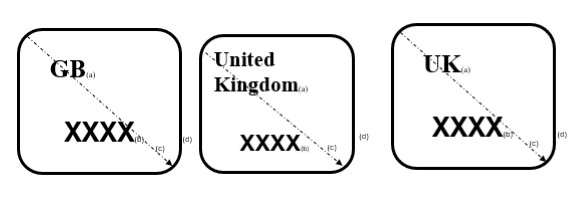
Figure 1: Illustration of the special mark
The special mark must be:Ìý
- “UKâ€�, “GBâ€� or “United Kingdomâ€� – letters 8mm highÌý
- XXXX – numbers 11mm high (where XXXX is the approval number of the premises, as referred to in point 7 of Part B or Section I of Annex II to Regulation (EC) No 853/2004)Ìý
- have a diameter of at least 30mm (to outer edge of border)Ìý
- have a 3mm thick borderÌýÌý
Where an identification mark is applied, such as to retail packaging, the size of the mark may vary according to the size of the packaging. However, it must be legible to the naked eye, indelible and the characters easily decipherable.Ìý
In the case of packaging containing cut meat or offal, the mark must be applied to a label fixed to the packaging, or printed on the packaging, in such a way that it is destroyed when the packaging is opened.Ìý
This is not necessary, however, if the process of opening destroys the packaging.Ìý
When wrapping provides the same protection as packaging, the label may be affixed to the wrapping.Ìý
The mark may be applied to the external surface of products of animal origin that are placed in transport containers or large packages. This includes containers or packages for further handling, processing, wrapping, or packaging in another establishment.Ìý
You are required to maintain the special mark on packaging or wrapping throughout the chain until it reaches the consumer.Ìý
General licence EXD 264(HPAI)(EW)Ìýallows for the special mark to be removed for the purposes of processing or repacking, subject to the conditions set out in the Schedule.Ìý
Retail butchers and catering establishments directly supplying the final consumer may remove the special mark and are not required to reapply it.Ìý
When unrestricted meat comes into contact with restricted meat, you must then treat it as though it is restricted meat.ÌýÌý
This includes meat which has come into contact at any stage of transport, storage, processing, or handing. In these circumstances the above conditions, including marking, must be applied.Ìý
Movement of restricted meat and productsÌý
General licence EXD 249(HPAI)(EW)Ìýallows movements subject to the conditions of that licence being met. Movement of restricted meat out of Great Britain cannot be authorised.Ìý
Requirements for premises to process meat during an outbreakÌý
Slaughterhouses are required to apply to theÌýFSAÌýfor designation if they are located:Ìý
- in a protection zone (PZ)Ìý
- in a surveillance zone (SZ)Ìý
- outside of theÌýPZÌýandÌýSZÌýand receive and process poultry originating from within theÌýPZÌýorÌýSZÌý
EmailÌýapprovals@food.gov.ukÌýto apply for designation.Ìý
These designations are defined as:Ìý
- Level 1 – slaughterhouses handling only unrestricted poultry originating from theÌýSZÌýor slaughterhouses located within theÌýPZÌýorÌýSZÌýreceiving poultry from outside theÌýPZÌýwhich will produce unrestricted meat during a bird flu outbreakÌýÌý
- Level 2 – slaughterhouses receiving poultry originating from within theÌýPZÌýwhich will produce restricted meat during a bird flu outbreakÌý
See theÌýlist of designated slaughterhouses. This information may change as the outbreak develops.Ìý
Disposal of waste and animal by-productsÌý
Level 2 designated slaughterhouses processing birds from theÌýPZÌýare required to adhere to the special animal by-product (ABP) categorisation and disposal rules in accordance withÌý, as amended:Ìý
- no restricted meat or related by-product is allowed to go into raw pet food productionÌý
- restricted meat is allowed to go into processed pet food production, but manufacturers must ensure any product falling into the restricted meat category is processed such that it is heat-treated to at least 70°C throughoutÌý
- when restricted meat or associated poultry carcase waste is collected, for disposal, the FBO will need a written confirmation from the rendering company that Category 3ÌýABPÌýmaterial will be subjected to a minimum heat treatment of 70°CÌý
- if the FBO does not have this confirmation, Category 3 ABPs from birds originating from aÌýPZÌýmust be disposed as Category 2ÌýABPÌýor aboveÌý
- if Category 3 ABPs from birds originating in theÌýPZÌýget mixed with Category 3ÌýABPÌýfrom birds outside theÌýPZ, the above controls apply to the entiretyÌý
All approved meat processing establishments handling restricted meat bearing the special mark are required to dispose of Category 3ÌýABPÌýthrough a route that involves heat treatment to a minimum of 70°C.Ìý
On-farm slaughtering
This guidance is for operators of on-farm slaughter facilities that have registered with theirÌýlocal authorityÌýfor a Primary Production exemption under EU Regulation (EC) No 853/2004.
You also need to have a county parish holding (CPH) number. You canÌýapply for a CPH numberÌýif you don’t have one already.
This guidance for on-farm slaughtering does not apply toÌý, including those located on farms.
Apply to be a designated on-farm slaughter facility
Once your facility is registered with your local authority, you must apply to the Animal and Plant Health Agency (APHA) to have your facility designated. You need to do this if:
- your farm is located in a protection zone (PZ) or surveillance zone (SZ)
- you plan to slaughter birds which originate from aÌýPZÌýorÌýSZ
EmailÌýoutbreak.licensing@apha.gov.ukÌýto request a designation approval form.
Apply for a specific licence to slaughter
Once you are designated, you must obtain a licence fromÌýAPHAÌýbefore slaughtering poultry at your on-farm facility if:ÌýÌý
- your facility is in aÌýPZÌýorÌýPZÌýÌý
- any of the birds on your farm are located within aÌýPZÌýorÌýSZ
This licence will include:Ìý
- a requirement for pre-slaughter inspection Ìý
- additional conditions for moving meat if you’re in a protection zone
Find out more about applying for a specific licence.Ìý
Supplying meat
Registered on-farm slaughter facilities can only supply of small quantities of fresh meat from poultry and lagomorphs (hares and rabbits) slaughtered on the farm.
You can supply this meat directly to:ÌýÌý
- the final consumerÌý
- local retail establishments that will sell it directly to the final consumer as fresh meat
Health and identification marks on meat
Registered on-farm slaughter facilities cannot apply a health or identification mark to meat.Ìý
At these establishments, you must not use the special mark described in the guidance above. Using it would suggest a level of meat inspection and control that does not apply to these premises.Ìý
Meat without a mark can only be sold within Great Britain (England, Scotland and Wales). It cannot be exported to third countries, including the EU.
Legal basis for this guidanceÌý
The following legislation is relevant to outbreaks ofÌýHPAI:Ìý
- Ìý