
Social media endorsements: guidance for content creators
Updated 3 September 2025

Ā© Crown copyright 2025
This publication is licensed under the terms of the Open Government Licence v3.0 except where otherwise stated. To view this licence, visit or write to the Information Policy Team, The National Archives, Kew, London TW9 4DU, or email: psi@nationalarchives.gov.uk.
Where we have identified any third party copyright information you will need to obtain permission from the copyright holders concerned.
This publication is available at /government/publications/social-media-endorsements-guidance-for-content-creators/social-media-endorsements-being-transparent-with-your-followers
Online content creators, such as bloggers, influencers, online streamers, celebrities and social media personalities, can have a big impact on a customerā€™s buying behaviour.Ā
If you use hidden ads or otherwise engage in misleading practices, you may be in breach of consumer protection law and face a substantial fine. It may also mean you could be breaking industry rules on advertising, which are enforced by the . Non-compliant content creatorsā€Æcan be for not abiding by advertising rules.
If youā€™ve been incentivised in any way to promote a brand or product in your social media content, itā€™s important that all this content is clearly identifiable as an ad (or advertising), and reflects your genuine experience.
ā€œProductā€ covers goods, services and digital content.
This rule applies to any content including:
- photos (including carousels)Ā
- ±¹¾±»å±š“Ē²õĢż
- °ł±š±š±ō²õĢż
- ²õ³Ł“Ē°ł¾±±š²õĢż
- ±č“Ē»å³¦²¹²õ³Ł²õĢż
- other posts online
This includes where youā€™ve been paid to post content, received a gift, or posted content about your own business.Ā
If youā€™re creating content for an online audience, whenever youā€™ve been incentivised to post, it must be clearly labelled as an advert or ad, and be based on your genuine experience.
This includes:Ā
- ²¹»å²õĢż
- ±š²Ō»å“Ē°ł²õ±š³¾±š²Ō³Ł²õĢż
- commercial relationships, including sponsorshipsĀ
- competitions, prize draws or giveawaysĀ
- affiliated links or programmesĀ
- discount codesĀ
- business partnershipsĀ
- own brand promotionsĀ
- product placementĀ
- °ł±š±¹¾±±š·É²õĢż
- content about gifts received for ā€˜freeā€™
Working with others
This guidance applies to both formal agreements, such as written contracts or other agreements, and to more informal arrangements, including verbal or other situations where youā€™ve been incentivised to promote, endorse or review a product.
It also includes businesses sending products or invites to events without asking for anything in return (ā€˜freebiesā€™ or ā€˜giftsā€™). It also applies where you post content about your own business too.Ā
Everyone involved in creating content like this on social media must take responsibility to ensure all ads are labelled correctly.
Any form of incentive or reward ā€“ including money, commissions, discounts, leases or loans free of charge or in more favourable terms than those offered to the general public, gifts of any products ā€“ is payment.
This guidance applies to you if youā€™ve received a product for free or at a discounted rate (or received other incentives, such as direct payment or commission) in connection with your social media accounts, no matter how many followers you have.
Avoid misleading your audience
Hidden ads are illegal and harmful as they can persuade people to buy things they might not usually buy if theyā€™d known that the content was not a non-biased opinion, review or recommendation.Ā
Posting about products or brands without labelling them as an ad can mislead your audience if you give the impression that you:
-
are a consumer when in fact youā€™re acting for your own businessesā€™ purposes, or on behalf of a brand (Brand Ambassador)Ā
-
have bought something, when this was given to you as a gift or on a loanĀ
-
have used the product yourself when you havenā€™tĀ
-
have claimed something in the content that you donā€™t know is true
Itā€™s a problem, and illegal, if you give the impression that any results youā€™ve claimed on social media are ones youā€™ve achieved or experienced first-hand when youā€™ve in fact been paid in some way to say it.
The content must also not make false or unsupported statements. For example, do not say that something tastes good, washes well, etc if you have not tried it.Ā Ā
Donā€™t claim something is eco-friendly if you canā€™t prove it. If you are trying to demonstrate the benefits of a beauty product donā€™t exaggerate the results through a video or photo filter on the platform.
Labelling ads
All commercial content must be correctly labelled and clearly identifiable as an ad. This also includes where you post about any gifts youā€™ve received, even if thereā€™s no obligation for you to do anything with it.Ā
To do this, all labels must be clear, prominent and easy to understand. It is not enough just to tag a brand in your post, use discount codes or affiliate links.
Easy to understand and easily defined (transparent and unambiguous)
You should use a label that clearly identifies your content as an ad, or advert, such as:Ā
- ad
- ²¹»å±¹±š°ł³ŁĢż
- ā€˜A¶Łā€™Ā
- ²¹»å±¹±š°ł³Ł¾±²õ¾±²Ō²µĢż
- advertisement
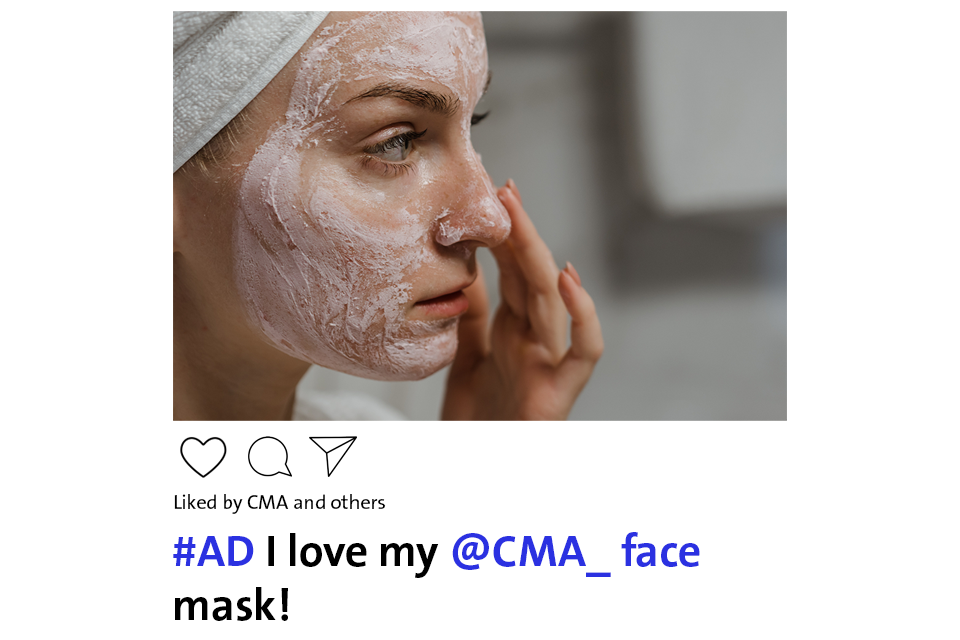
Image showing simulated advert on Instagram
The above image is an example of a post, which in the CMAā€™s view, would likely comply with the requirements of consumer protection law.Ā
Some platforms have tools to label content automatically, like ā€˜paid partnershipā€™ or ā€˜branded contentā€™. You can also use these provided the label is clear and easy to see or access.Ā
You should consider whether the labelling tool clearly conveys that the content is an ad; if not, you should include the label #Ad in a clear, upfront position.
Words to avoid
You should avoid unclear or ambiguous terms such as:Ā
- ā€˜#²µ¾±“Ś³Łā€™
- ā€˜#²µ¾±“Ś³Ł±š»åā€™Ā
- ā€˜#²¹“Ś“Śā€™Ā
- ā€˜#²¹“Ś“Ś¾±±ō¾±²¹³Ł±šā€™
- ā€˜#³¦“Ē±ō±ō²¹²śā€™Ā
- ā€˜#±Źøé°Õ°ł¾±±čā€™Ā
- ā€˜#²õ±č“Ē²Ōā€™Ā
- ā€˜#²õ±č“Ē²Ō²õ“Ē°ł±š»åā€™
- ā€˜Funded byā€™Ā
- ā€˜In association withā€™Ā
- ā€˜made possible byā€™Ā
- ā€˜my productsā€™Ā
- ³¾²ā²ś°ł²¹²Ō»åā€™Ā
- ā€˜o·É²Ō²ś°ł²¹²Ō»åā€™Ā
- ā€˜PR Haulā€™Ā
- ā€˜PR Stayā€™Ā
- ā€˜thank youā€™Ā
- or just naming the brand
Clearly shown in posts (prominent)
Your audience should be able to understand that your content is an ad, as soon as they access or engage with it, regardless of the format or media used.Ā
Disclosure labels should not be hidden or buried in many other hashtags or poorly contrasted with the content background.Ā
It must be immediately clear that your content is an ad. Your audience should not have to:
- scroll or select the link for more informationĀ
- re-size the screen on a device to access the contentĀ
- study the content carefully to see the disclosureĀ
- access your profile page or bioĀ
- already be aware of previous content youā€™ve posted
If they do, you will need to adjust or edit your content to ensure your audience can recognise itā€™s an ad.
Ad is obvious from the first interaction (timely)
All promotional content should be labelled as advertising, and this must be obvious as soon as anyone engages with the content.Ā
This includes content such as podcasts or videos, where the disclosure for ads must be given at the beginning of the ad.Ā
If you use carousels (video or photos), or sequences where your audience can access individual posts: you must also label each item that contains promotional messaging.
Working with multiple brands
You should be clear which brands youā€™re advertising for in your post.
Your own brand or products
If you own (in full, co-own or in part), or are employed by or otherwise connected with a brand and use your social media account to promote it or its products, you must make this known and clearly label these posts as ads. If you are promoting any brand that you, your family, or your friends own, it needs to disclosed as advertising.
To see examples, visit Advertising Standard Authority (ASA)ā€™s rulings forĀ ,Ģż and .
You should not rely on your bio, previous posts or selecting links for more information for your followers to discover what relationship you have with the brand youā€™re promoting or advertising. This should be clear from the face of the content.
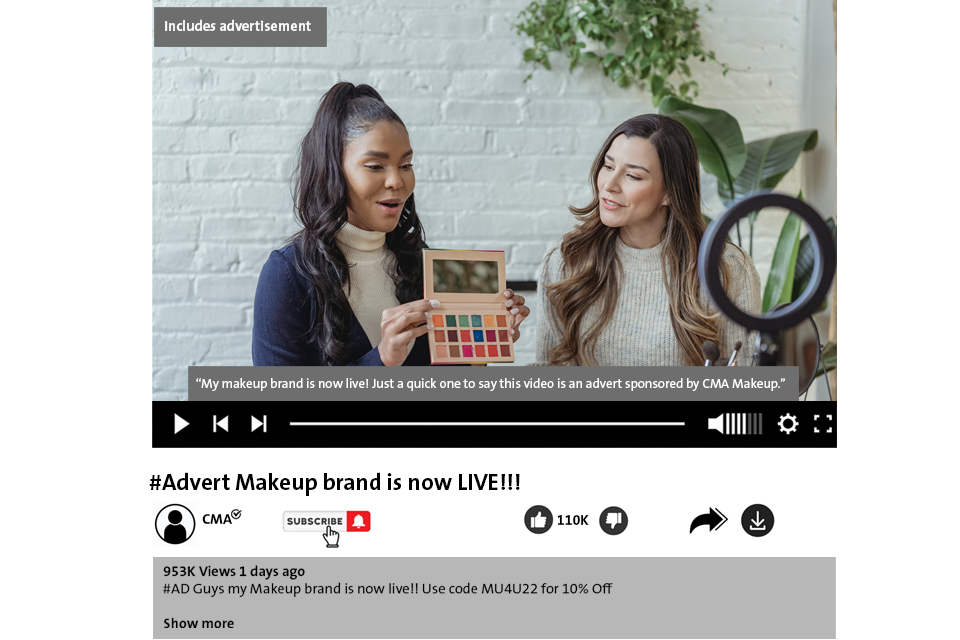
Image showing simulated advert on YouTube.
The above image is an example of a video endorsement, which in the CMAā€™s view, would likely comply with the requirements of consumer protection law.
More information
You could face enforcement action from the CMA, local authority Trading Standards Services, or the Department for the Economy in Northern Ireland if your content misleads consumers.
For more guidance, see:
-
CMA guidance collection onĀ online reviews and endorsements and the CMAā€™s case finder, for detail on previous and ongoing casework
-
The Committee of Advertising Practice (CAP) and CMA Ā explains how to comply with consumer protection law and the Advertising Codes enforced by the ASA. You can also visit on this topic.
-
ASA research onĀ
These materials do not constitute legal advice and should not be relied upon as such.