UK AI Hardware Plan
Published 8 June 2026

© Crown copyright 2026
This publication is licensed under the terms of the Open Government Licence v3.0 except where otherwise stated. To view this licence, visit or write to the Information Policy Team, The National Archives, Kew, London TW9 4DU, or email: psi@nationalarchives.gov.uk.
Where we have identified any third party copyright information you will need to obtain permission from the copyright holders concerned.
This publication is available at /government/publications/uk-ai-hardware-plan/uk-ai-hardware-plan
Foreword by the Secretary of State for Science, Innovation and TechnologyÌýÌý

Artificial intelligence will define the economic and security landscape of the coming decades. But AI does not exist in the abstract. It depends on physical systems - chips, advanced materials, and the skills and infrastructure that bring them together. To lead inÌýAI, andÌýdeliver on the ambition set out in the AI Opportunities Action Plan, we must also lead in the hardware that underpins it. This means strengthening the UK’s capability in the technologies that matter most, while working with trusted partners to ensure resilience,ÌýaccessÌýand long-term economic security.ÌýÌý
The UK enters this moment with real strengths: world-leading research, globally competitive design capabilities, and a vibrant ecosystem of innovative companies. But we also face increasing concentration of supply, intensifying geopolitical competition, and growing vulnerability in the critical technologies that power modern economies.ÌýÌý
This plan sets out how we will respond.ÌýÌý
It marks an evolution in how government supports the UK semiconductor sector to harness its strengths in AI hardware - moving from a set of individually strong but fragmented activities to a more coherent, system-level strategy. One that better connects early-stage innovation to deployment, procurement to investment, and skills to long-term capability.ÌýÌý
At its core, this is about three things.ÌýÌý
First, it is about backing British companies - ensuring that our most promising innovators can develop,Ìýdemonstrate, and scale their technologies here in the UK to compete globally. Too often, breakthrough ideas generated in the UK are commercialised elsewhere. This plan is about changing that trajectory.ÌýÌý
Second, it is about building sovereign capability in the technologies that matter most for AI - from the design of advanced chips to emerging semiconductor paradigms such as photonics and edge AI inference. We will notÌýseekÌýto replicate every part of global supply chains. But we will ensure that the UK has strength, resilience, and strategic leverage in the areas most critical to our future, through an open and globally integrated approach grounded in trusted partnerships. This includes continuing to work with established global providers to accessÌýcutting-edgeÌýtechnologies, while backing British companies to develop and compete globally.ÌýÌý
Third, it is about translating capability into real-world impact - accelerating adoption across the economy, supporting new industries, and ensuring that the benefits of AI are widely felt. That means linking innovation more directly to deployment, including through public procurement, industrial partnerships, and targeted investment.ÌýÌý
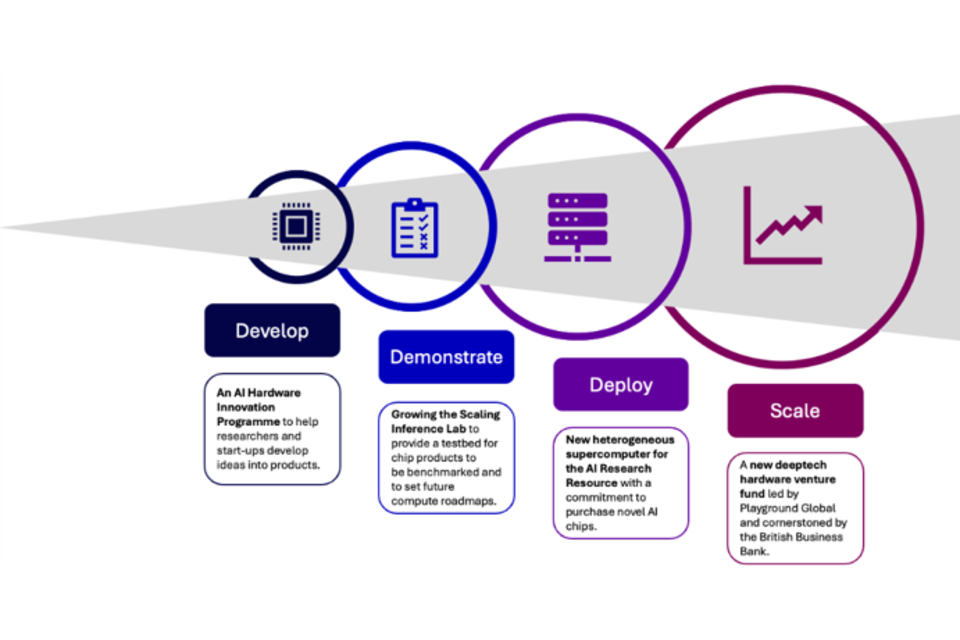
We are taking a phased approach: to develop andÌýdemonstrateÌýthe technologies of the future; deploy them into real-world settings; and scale the companies and capabilities that will anchor long-term growth.ÌýÌý
This Plan is a long-term commitment to securing the foundations of our AI economy. Ensuring that the UK is not only a participant in global supply chains, but a country with enduring capability,ÌýresilienceÌýand influence within them. The UK hasÌýa clear choice: to remain dependent on technologies developed and controlled elsewhere, or to act with ambition – building the capabilities, international partnerships and leadership needed to compete fiercely and secure its place in the future of AI hardware. This plan is about choosing the latter.ÌýÌý
The Rt Hon Liz Kendall MP,ÌýÌý
Secretary of State for Science, Innovation and TechnologyÌýÌý
·¡³æ±ð³¦³Ü³Ù¾±±¹±ðÌý²õ³Ü³¾³¾²¹°ù²âÌýÌýÌý
AI is a general-purpose technology reshaping the global economy and a core source of economic and strategic power. The UK’s objective in itsÌýModern Industrial StrategyÌýand associatedÌýDigital and Technologies Sector PlanÌýis to build strategic advantage in the technologies that matter most - not through isolation, but by securing a leading role in the global ecosystem, as an indispensable partner in areas where the UK can build real and sustained advantage.ÌýÌý
The AI stack is evolving quickly. While global computeÌýremainsÌýhighly concentrated, the hardware that underpins it is diversifying. Different AI workloads - from training and inference to edge and embodied AI - increasingly require specialised architectures and system designs. This reflects a shift from centralised model training towards more distributed and application-specific computing. This shift is creating new opportunities across the stack, enabling a more diverse and resilient ecosystem and opening space for new entrants. It also reinforces the need for AI systems that are secure by design, with hardware playing a critical role in enabling safe and trustworthy adoption at scale.ÌýÌý
This is a major economic opportunity. AI hardware - the semiconductor technologies that underpin AI - is one of the fastest-growing segments of the global economy, central to productivity growth, high-value jobÌýcreationÌýand economic resilience. Capturing value in this space will be critical to the UK’s long-term position in AI and its role in global supply chains.ÌýÌý
The UK is well placed to lead in the future hardware technologiesÌýrequiredÌýfor AI. It combines world-leading strengths in chip design and IP, a growing base of innovative AI hardware firms, and differentiated capability in enabling technologies such as photonics and advanced materials. These strengths are increasingly co-locating in practice – with the UKÌýemergingÌýas a major hub for frontier AI labs - creating a unique opportunity to bring hardware, models and real-world workloads together.ÌýÌý
This Plan sets out how the UK will convert those strengths into scaled capability, backed by over £1.1 billion of targeted public and private investment.ÌýIt aims to build globally competitive AI hardware companies in the UK, including through attracting and anchoring international investment; maximise the adoption of UK-developed technologies across AI systems; and establish the UK as one of the leading places in the world for next-generation AI hardware. It is centred on building an end-to-end AI hardware innovation pipeline, enabling companies to move from research and early-stage product development through to deployment and global scale.ÌýÌýÌý
This pipeline provides a clear pathway for companies and investors to engage:ÌýÌý
-
DevelopÌý- supporting breakthrough R&D and early-stage innovationÌýÌý
-
DemonstrateÌý- enabling prototyping, testing and validation in real-world environmentsÌýÌý
-
DeployÌý- creating early markets through procurement and integration into operational systemsÌýÌý
-
ScaleÌý- unlocking investment and anchoring growth in the UKÌý
At its core, this is about creating an ecosystem that reduces technical, capital, market and security risks as companies scale - linking innovation to real-world demand and providing a clear route from idea to global commercialisation. This includes strengthening the secure-by-design foundations of AI adoption, by backing hardware technologies that reduce or eliminate critical vulnerabilities such as memory-safety flaws, where the UK has distinctive strengths.ÌýÌý
We will deliver this through four aligned pillars - innovation, skills, procurement and investment - together creating a coherent and investable ecosystem. This will be delivered in close partnership with international allies, reflecting the UK’s role as a key contributor within global semiconductor and AI supply chains. This ensures that, as the UK accelerates AI adoption and invests in compute infrastructure, a growing share of value is captured through UK-designed technologies and firms, reducing exposure to critical supply-chain dependencies and supporting security of supply and long-term resilience. International partnerships will be integral to each pillar, drawing on complementary strengths across research, design,ÌýmanufacturingÌýand system integration, and supporting collaboration in the global ecosystems shaping the future of AI hardware.ÌýÌýÌý
The Plan builds on theÌýAI Opportunities Action PlanÌýand complements wider work on AI models,ÌýsafetyÌýand adoption, aligning with the government’s Modern Industrial Strategy and Digital and Technologies Sector Plan - strengthening the UK’s position across the 6 frontier technologies and deepening partnerships with international allies.ÌýÌý
Summary of interventionsÌýÌý
These interventions back British companies by creating clear opportunities for UK AI hardware firms to develop, demonstrate,ÌýdeployÌýand scale in the UK, and compete globally. Together, they represent over £1.1 billion of targeted support across innovation, skills,ÌýprocurementÌýand investment.ÌýÌý
±õ²Ô²Ô´Ç±¹²¹³Ù¾±´Ç²ÔÌýÌýÌý
-
´¡Ìý£120m investment in AI hardware innovationÌý¾±²Ô³¦±ô³Ü»å¾±²Ô²µ:ÌýÌý
-
´¡²ÔÌýAI Hardware Innovation Programme, designed in partnership with UKRI and the UK Semiconductor Centre, to support UK-based companies toÌýdevelopÌýtechnologies through prototyping support, collaborative R&D, early-stageÌýgrantsÌýand targeted mission-driven programmes. The programme will provide structured support from feasibility to commercialisation, helping UK AI hardware companies move from concept toÌývalidatedÌýprototype.ÌýÌýÌý
-
´¡²ÔÌýexpanded Scaling Inference Lab, withÌýadditionalÌýfunding of at least £20m to support more companies and larger-scale system builds for evaluation, delivered in partnership with ARIA andÌýCommonAIÌýand building on ARIA’s existing £50m investment in this area. This will build a national capability for testing andÌývalidatingÌýnew AI compute systems, enabling companies toÌýdemonstrateÌýperformance on real-world workloads and integrate technologies into full systems, reducing risk for investors and customers. It is designed to grow into a world-leading facility, supporting UK companies to scale and compete globally, including byÌýshowcasingÌýnew hardware to major AI customers such asÌýhyperscalersÌýand frontier AI labs.ÌýÌý
-
-
A newÌý£18m Hardware Security R&D Programme, strengthening the secureÌýdeploymentÌýandÌýscalingÌýof AI hardware, including in areas such as memory security, by supporting collaboration across government, industry and academia, bridging the gap between research and commercial integration and strengthening the UK’s broader hardware security capabilities.ÌýÌý
-
A refocusedÌýSemiconductor Catapult, building on the existing Compound Semiconductor Applications Catapult to focus on AI hardware and support UK-based companies to integrate andÌývalidateÌýsystems as they move towardsÌýdeployment.ÌýÌýÌý
-
´¡Ìýtrusted network of manufacturing and foundry partners, built through the UK Semiconductor Centre, providing UK innovators with access to a clear pathway from research, design and prototyping to production andÌýscale.Ìý
³§°ì¾±±ô±ô²õÌýÌýÌý
-
´¡²ÔÌý£80m investment in semiconductor and AI hardware skills, ¾±²Ô³¦±ô³Ü»å¾±²Ô²µ:ÌýÌý
-
An expansion of theÌýSemiconductor skills programmeÌýto £48m, delivering increased undergraduate bursaries in subjects such as electrical and electronic engineering and materials science - growing from 300 in academic year 25–26, to 400 in 26–27, and 500 in 27–28; alongside an expanded schools outreach programme and teaching fellowships to grow the UK’s chip design capability and support scale-ups.ÌýÌý
-
A new £12mÌýCentre for Doctoral Training (CDT) in Chip Design, strengthening the long-term talent pipeline in chip design and AI hardware, supporting advanced research and early-stage innovation.ÌýÌý
-
A new £20m targetedÌýinvestment of the TechFirst programme, supporting 500 more UK PhD students to access top up funding and support throughout their PhD. This will attract new UK talent and strengthen sovereign AI hardware capability by increasing the proportion of UK-trained researchers in strategically critical fields and supporting the retention of high-value talent within the UK.ÌýÌý
-
-
Work with employers to identify pathways into semiconductor and AI hardware careers, led by Skills England, DWP and the UK Semiconductor Centre, through a review of the Growth and Skills Levy-funded offer - including apprenticeships - as well as other relevant funded provision, to strengthen the pipeline of chip design and verification engineers; to develop the skills and pathways this vital industry needs; and to support more young people to understand and access careers in AI hardware.ÌýÌý
-
´¡ÌýStrategic Industry Partnership with ArmÌýthrough TechFirst, supporting the development of the UK’s future AI hardware workforce through industry engagement,ÌýexpertiseÌýand alignment of training withÌýreal‑worldÌýchip design needs.Ìý
±Ê°ù´Ç³¦³Ü°ù±ð³¾±ð²Ô³ÙÌý
-
A newÌý£750m heterogeneous AI supercomputer for the AI Research Resource (AIRR), enabling different types of advancedÌýcomputeÌýtechnologies, including novel AI architectures and, over time, quantum computing, to be integrated within a single system and used on real research workloads – reflecting the growing shift towards heterogeneous, inference-optimised systems and supporting deployment and performance validation in practice.ÌýÌý
-
´¡Ìý£400m procurement opportunity forÌýspecialised chipsÌýwithin this £750m AIRR heterogeneous supercomputer programme. This comprises an expanded Advanced Market Commitment (AMC) of £150m - up from £100m announced previously - to purchase novel, high-performance inference chips, to be awarded this summer, followed by a further £250m procurement for additionalÌýspecialisedÌýhardware. This will create a significant commercial opportunity for AI hardware companies, including the strong pipeline of UK firms, and support the deployment and scaling of new technologies in the UK. In doing so, it will help establish the UK as a leading market for next-generation AI hardware and strengthen our position in this strategically important segment.ÌýÌýÌýÌý
-
A new digital procurement model through theÌýmulti-billion pound National Cloud Infrastructure Programme (NCIP), providing opportunities for UK AI hardware companiesÌýto deploy at scale in cloud infrastructure and demonstrate readiness for global markets.Ìý
±õ²Ô±¹±ð²õ³Ù³¾±ð²Ô³ÙÌýÌý
-
´¡ÌýnewÌýdeeptechÌýhardware venture fund, led by Playground Global,Ìýbacked by up to £150m from the British Business Bank – its largest fund investment to date. The fund will provide capital to help UK AI hardware firms scale, crowd in private investment, and anchor capability in the UK. Playground Global isÌýestablishingÌýits first office outside the US in the UK to support this activity and deepen engagement with the UK’s research and innovation ecosystem.ÌýÌý
-
Support for AI hardware companies through theÌý£500m Sovereign AI Fund, which is prioritising compute. The Fund will invest in high-potential UK AI hardware companies to accelerate growth and scale-up. It will work with ARIA and the Scaling Inference Lab to validate new technologies and build a pipeline for deployment into UK AI infrastructure, including the AI Research Resource (AIRR).ÌýÌý
-
Support forÌýUK AI hardware companies to access financing through UK Export FinanceÌý(UKEF), enabling firms to scale internationally. UKEF can provide financing through products such as the Export Development Guarantee and General Export Facility, supporting companies to invest in capacity, manage delivery risk and grow export capability. This includes exploring financing models that enable the deployment of UK hardware within data centre infrastructure, supporting future exports and overseas contracts.ÌýÌý
-
Support for UK AI hardware companies to scale internationally byÌýnavigating export requirements. The government’s Export Control Joint Unit (ECJU) is working with UK chip designers to ensure that export licences, where required, are best designed to meet the needs of companies while complying with the UK’s security obligations. ECJU, which already operates one of the most transparent licensing regimes in the world, will also work with new entrants and start-ups in the sector to advise them on any export licensing requirements, and provide appropriate support for them in the application process where licences are required.Ìý
The opportunity and case for actionÌýÌý
AI is one of the most transformative technologies toÌýemergeÌýsince the industrial revolution and capabilities in AI willÌýdetermineÌýthe global balance of power in the 21st Century. The AI Opportunities Action Plan set out a goal for the UK to have a thriving domestic AI ecosystem with serious players at multiple layers of the “AI stackâ€�,Ìýpositioning the UK to be an AI maker, not an AI taker.ÌýÌýÌý
One of the most important strategic capabilities in this stack, and the biggest single economic growth engine within it, is the semiconductor hardware on which AI runs. The AI chip industry is one of the fastest growing segments of the global economy, growing at an average rate of 30% p.a. [footnote 1]. AI is by far the biggest driver of demand in the global semiconductor industry as a whole, which is predicted to be worth over $1 trillion by 2030 [footnote 2]. The world’s most valuable company is an AI chip company, Nvidia, as is the UK’s most valuable company,ÌýArm.ÌýÌýÌý
AI hardware should be understood as the chips and semiconductor technologies that underpin AI, required to enable capability across data centre, edge and embodied AI systems. This includes all the electronic and photonic components of AI systems and the related capability across chip design, manufacturing and system integration, spanning:ÌýÌý
-
ComputeÌý- AI chips and accelerators for training,ÌýinferenceÌýand edge use, including architectures and chip design (spanning CPUs, GPUs/TPUs, AI ASICs etc.). Key technology trends in this area include chiplets/heterogeneous integration/3D packaging, novel computer architectures such as quantum computing and neuromorphic computing, and photonic approaches to improve bandwidth,ÌýlatencyÌýand energy efficiency.ÌýÌý
-
Photonic interconnects and data movementÌý-Ìýchip‑to‑chip, board‑ÌýandÌýsystem‑levelÌýconnectivity, including integrated photonics andÌýco‑packagedÌýoptics, as well as memory and data storage technologies which are increasingly critical to scaling AI systems.ÌýÌý
-
SensingÌý- sensors and front-end devices that generate and pre-process data for AI systems, including vision, radar, lidar, RF-based sensing and photonic sensing where they deliver advantages in speed, precision or energy efficiency, and which are particularly important for edge and embodied AI applications such as robotics and autonomous systems.ÌýÌý
-
Power and energy systemsÌý- power electronics that make use of advanced materials such as silicon carbide and gallium nitride for efficiency and thermal management, and which are fundamental to scalable,Ìýcost-effectiveÌýand sustainable AI compute.Ìý
Why now?ÌýÌýÌý
The landscape for AI hardware is currently heavily concentrated in a small number of large companies, but the market is diversifying, and the pace of change is accelerating. The continued transformative expansion of AI is constrained by the availability of computational power and the energyÌýrequiredÌýto sustain it, making innovation inÌýenergy‑efficientÌýAI compute essential.ÌýÌý
The vast economic opportunity combined with the imperative to increaseÌýpowerÌýand efficiency isÌýopening upÌýnew frontiers and market opportunities. The technology is moving beyond general-purpose GPUs and CPUs towards application-specific chips, particularly those tailored towards inference, edge and embodied AI, AI agents and specific AI models. This is creating increasing diversification of the AI chip sector, and a trend towards heterogeneous compute systems combining multiple chips for specific AI workloads.ÌýÌýÌý
Finally, the increase in demand for AI hardware is creating opportunities not only inÌýAIÌý processors, but also a wide range of enabling hardware technologies, including optical data transfer, power management, and sensors for edge and embodied systems. At the same time, the rapid development of AI systems is exposing new vulnerabilities at the hardware level, particularly those linked to memory security. This creates an opportunity for the UK to build on its strengths in hardware security and lead in developing secure-by-design hardware that better protects sensitive information and supports more trustworthy AI adoption at scale, including through approaches such as CHERI - a UK-developed technology that builds security directly into the processor.ÌýÌý
UK strengthsÌýÌý
The UK is a global leader in AI and has made major investments in compute capability to reinforce this position.ÌýThe Compute Roadmap (2025)Ìýoutlines the Government’s approach, including a major scaling up of public AI compute capability via over £1 billion of investment in the AI Research Resource, a massive expansion in private sector-led onshore AI data centres through AI Growth Zones, with £28ÌýbillionÌýof private investment confirmed, and an ambition to leverage the UK’s AI and wider compute ecosystem as a pull-through mechanism for innovative technology. This is creating a significant increase in demand for hardware in the UK, and an opportunity to use government procurement to support innovation.ÌýÌý
To maximise both the economic impact of these compute investments and strengthen the UK’s sovereign capabilities within the AI hardware stack, a more joined-up approach is needed – one that links innovation to deployment and ensures UK-developed technologies can be adopted and scaled within real-world systems, while continuing to work with international partners across global supply chains.ÌýÌý
The UK has differentiated strengths within industry and academia across a range of AI enabling semiconductor technology areas, ¾±²Ô³¦±ô³Ü»å¾±²Ô²µ:ÌýÌý
-
The headquarters of the world’s largest chip design IP company, Arm, whose technology is present in many of the mostÌýcutting-edgeÌýAI chips and is now producing its own CPU chip for agentic AI.ÌýÌý
-
The largest tech startup ecosystem outside of the US and China, with a strong and growing pipeline of AI hardware companies and a significant share of European venture capital investment, including leading firms such asÌýFractile, OLIX,ÌýLumai, Oriole Networks and Salience Labs - with some already achieving unicorn status.ÌýÌý
-
Leading materials science and specialist manufacturing in areas such as compound semiconductors and photonics, which are of increasing importance in the technologies that enable AI, such as data transfer and storage, power management and optical compute, including large-scale semiconductor fabs run by multinationals such as Seagate and Vishay Intertechnology.ÌýÌý
-
A world-leading research base with a long history in computer science, electronic and photonic engineering, and quantum computing.ÌýÌý
-
Some of the world’s mostÌýcutting-edgeÌýexpertiseÌýin high performance computing and large-scale national supercomputing facilities such as the Edinburgh Parallel Computing Centre, Isambard AI in Bristol, DawnÌýand alsoÌýnow Zenith in Cambridge.ÌýÌýÌý
-
Leading capability in hardware security, including CHERI, a UK-developed secure-by-design technology that canÌýeliminateÌýwhole classes of cyber vulnerabilities, positioning the UK to provide trusted foundations for secure AI adoption and complement its strengths in AI models and compute infrastructure.Ìý
The UK is thus uniquely well placed to take advantage of the vast economic opportunity presented by AI hardware and to build this into the wider UK AI ecosystem outlined in the AI Opportunities Action Plan, Compute Roadmap and the Digital and Technologies sector plan, part of the Government’s Modern Industrial Strategy. However, in an increasingly competitive and capital-intensive global landscape, market forces alone are unlikely to fully translate these strengths into scaled UK capability. Targeted action isÌýrequiredÌýto reduce risk, coordinate investment, and ensure that UK firms can move from innovation to deployment and capture a greater share of the value created.ÌýÌý
CaseÌýstudyÌý- ArmÌýÌý
Arm is a UK technology success story founded in Cambridge that underpins the global semiconductor ecosystem. Arm-based technology reachesÌýnearly 100%Ìýof the global connected population and is increasingly powering cloud computing, AI infrastructure, automotive platforms, and billions of connected devices worldwide. The evolution of the Arm compute platform, including production of silicon products for the first time, marks a significant expansion in the company’s strategy and will allow Arm to capture more value in the rapidly growing AI hardware market. This transition reflects a broader “gear changeâ€� across the UK semiconductor ecosystem, enabling the country to compete in next-generation compute systems.ÌýÌý
Our approach: Building the AI hardware pipelineÌýÌý
Our goal is to secure Britain’s future capability and strategic advantage in the chips and semiconductor technologies that underpin AI.ÌýÌýÌý
We will achieve this by:ÌýÌý
-
Building globally competitive AI hardware companies in the UK;ÌýÌýÌý
-
Maximising the adoption of UK-developed technologies in AI systems across data centre,ÌýedgeÌýand embodied AI; andÌý
3.ÌýEstablishingÌýthe UK as one of the leading places in the world to develop,Ìýdemonstrate, deploy and scale next-generation AI hardware.ÌýÌýÌý
Through this approach we aim to anchor a growing share of high-value AI hardware activity and industrial capability in the UK, from both UK and internationally headquartered firms.ÌýÌý
This Plan is centred on building an end-to-end AI hardware innovation pipeline, enabling UK companies to progress from early-stage innovation through to deployment and scale. The pipeline is designed to reduce technical,ÌýcapitalÌýand market risk, and to ensure that UK-developed technologies are driven by real-world systems and applications. Security and resilience are embedded as core capabilities across the pipeline, including through secure-by-design hardware approaches such as CHERI, and by positioning UK firms within global supply chains to strengthen security of supply and long-term resilience and competitiveness.ÌýÌý
This means creating a clear pathway fromÌýdevelopÌý→ÌýdemonstrateÌý→ÌýdeployÌý→Ìýscale, ensuring that companies can access the right capabilities and support at each stage through a set of targeted interventions, anchored in access to real-world compute environments and linked directly to sources of demand. This includes strengthening the UK’s ability to prototype andÌývalidateÌýtechnologies, integrate them into operational systems, and deploy them at scale - both domestically and globally.ÌýÌý
This approach recognises both the urgency of near-term opportunities and the long-term nature of building capability in AI hardware. While we are acting now to support companies to deploy and scale emerging technologies - including through procurement,ÌýtestbedsÌýand investment - developing globally competitive hardware capabilities requires sustained effort over many years. This Plan therefore combines immediate interventions to capture current opportunities with a long-term commitment to building enduring strength across the pipeline, from research through to global scale.ÌýÌý
We will deliver this pipeline through four linked pillars, aligned with the government’s Modern Industrial Strategy, building UK capability while working with international partners to draw on complementary strengths – strengthening resilience, deepening integration into global supply chains, and creating opportunities for UK businesses to grow and scale.ÌýÌýÌý
±õ²Ô²Ô´Ç±¹²¹³Ù¾±´Ç²ÔÌýÌý
Enabling novel AI hardware technologies to be developed and demonstrated, with support for R&D and clear pathways to real-world application - including through a new AI Hardware Innovation Programme and testbeds such as the Scaling Inference Lab set up by ARIA and run by Common AI, and in collaboration with international partners.ÌýÌý
³§°ì¾±±ô±ô²õÌýÌý
Building the workforce needed across the AI hardware pipeline, from advanced research through to deployment and scale, including schools outreach, undergraduate programmes, and doctoral training.ÌýÌý
±Ê°ù´Ç³¦³Ü°ù±ð³¾±ð²Ô³ÙÌýÌý
Creating early markets and routes to adoption by using public procurement to support deployment in real-world systems - including the use of advance market commitments for the AI Research Resource (AIRR) to support the development of novel hardware technologies, and routes to deploy at scale in cloud infrastructure through the new National Cloud Infrastructure Procurement (NCIP).ÌýÌý
±õ²Ô±¹±ð²õ³Ù³¾±ð²Ô³ÙÌýÌý
Unlocking the capital required for scale, through public-private investment vehicles and partnerships that enable UK firms to grow, commercialise and compete globally.ÌýÌý
±õ²Ô²Ô´Ç±¹²¹³Ù¾±´Ç²ÔÌýÌý
The UK’s objective is to build a strong cohort of competitive AI hardware companies that can be deployed and scaled in the UK and globally. This is central to the UK’s long-term position in AI: success will depend not only on world-class research, but on our ability to translate early-stage innovation into deployable technologies and globally competitive firms.ÌýÌý
The UK has strength in AI hardware, including chip design, advanced materials and a world-class research base in areas such as photonics, heterogeneous integration, novel compute architectures and hardware security. It is home to a growing cohort of companies developing next-generation AI hardware technologies. However, without targeted action, the UK risks generating breakthrough ideas without capturing the commercial, strategic and productivity gains that follow, or enabling companies to stay in the UK and scale.ÌýÌý
The approachÌýÌý
The government will support AI hardware companies to develop and demonstrate their technologies, enabling them to move from early-stage innovation through to deployment and scale. We will address key barriers to growth, including access to early-stage funding for prototyping, product development and startup creation - a well-known ‘valley of death’ in hardware - alongside improved access to scale-up capital, helping to crowd in private sector VC and R&D investment.ÌýÌý
Access to infrastructure and facilities for product development is a significant constraint. Design, prototyping,ÌýpilotingÌýand manufacturing capabilities are essential to move from concept to deployable product. While the UK has excellent research facilities andÌýsmall‑scaleÌýprototyping capability, access toÌýpilot‑scaleÌýinfrastructureÌýremainsÌýconstrained, andÌýleading‑edgeÌýfabrication is concentrated globally and difficult for SMEs to access. We will lower these barriers by improving access to EDA tools and to prototyping and production capability, through targeted domestic capability where the UK has strengths, and structured international partnerships to ensure reliable access to overseas facilities.ÌýÌý
We will also enable application‑ÌýandÌýsystem‑ledÌýinnovation linked to customers and end users. Deployment and validation require integration intoÌýreal‑worldÌýsystems, yet UK companies often face barriers to accessing these environments and markets, limiting their ability toÌýdemonstrateÌýperformance and secure commercial adoption. We will increase access toÌýsystem‑levelÌýdemonstration and testing capability andÌýfacilitateÌýconnections to end customers, creating clear routes to deploymentÌýpost‑validation.ÌýÌý
This activity will build on the existing interventions announced in the Digital and Technologies Sector Plan, part of the UK’s Modern Industrial Strategy, including measures to increase access to chip design capability for SMEs via a pilot Chip Design Enablement Programme, and access to design and tape-out capability in the research community through the System-on-Chip Design Accelerator, providing access to a SoC design platform and Arm IP for UK researchers. These will complement the recently established Innovation and Knowledge Centres focused on commercialising emerging semiconductor technologies from UK universities, including in neuromorphic computing (Neuroware, led by UCL), heterogeneous integration system design (CHIMES, led by the University of Sheffield), silicon photonics (Cornerstone, led by the University of Southampton), and advanced materials for power electronics (REWIRE, led by the University of Bristol).ÌýÌý
The interventionsÌýÌý
-
A £120m investment in AI hardware innovation ¾±²Ô³¦±ô³Ü»å¾±²Ô²µ:ÌýÌý
-
´¡²ÔÌýAI Hardware Innovation Programme, designed in partnership with UKRI and the UK Semiconductor Centre, to support UK-based companies toÌýdevelopÌýtechnologies through prototyping support, collaborative R&D, early-stageÌýgrantsÌýand targeted mission-driven programmes. The programme will provide structured support from feasibility to commercialisation, helping UK AI hardware companies move from concept toÌývalidatedÌýprototype.ÌýÌýÌý
-
´¡²ÔÌýexpanded Scaling Inference Lab, withÌýadditionalÌýfunding of at least £20m to support more companies and larger-scale system builds for evaluation, delivered in partnership with ARIA andÌýCommonAIÌýand building on ARIA’s existing £50m investment in this area. This will build a national capability for testing andÌývalidatingÌýnew AI compute systems, enabling companies toÌýdemonstrateÌýperformance on real-world workloads and integrate technologies into full systems, reducing risk for investors and customers. It is designed to grow into a world-leading facility, supporting UK companies to scale and compete globally, including byÌýshowcasingÌýnew hardware to major AI customers such asÌýhyperscalersÌýand frontier AI labs.ÌýÌý
-
-
A newÌý£18m Hardware Security R&D Programme, strengthening the secureÌýdeploymentÌýandÌýscalingÌýof AI hardware, including in areas such as memory security, by supporting collaboration across government, industry and academia, bridging the gap between research and commercial integration and strengthening the UK’s broader hardware security capabilities.ÌýÌý
-
A refocusedÌýSemiconductor Catapult, building on the existing Compound Semiconductor Applications Catapult to focus on AI hardware and support UK-based companies to integrate andÌývalidateÌýsystems as they move towardsÌýdeployment.ÌýÌý
-
´¡Ìýtrusted network of manufacturing and foundry partners, built through the UK Semiconductor Centre, providing UK innovators with access to a clear pathway from research, design and prototyping to production andÌýscale.Ìý
°ä²¹²õ±ðÌý²õ³Ù³Ü»å²âÌý-Ìý³¢³Ü³¾²¹¾±Ìý
LumaiÌýis an Oxford-based AI hardware company developing optical computing processors that use light to perform AI computations instead of electrons. The company’s novel 3D optical computing approach - enabling parallel processing of AI workloads in three-dimensional space – is delivering improvements in performance and energy efficiency compared to conventional silicon techniques. Spun out of the University of Oxford and built on years of world-leading research in photonics and machine learning,ÌýLumaiÌýis a good example of how the UK’s strong academic base and deep R&D capability can translate into frontier AI hardware innovation.ÌýÌýÌý
³§°ì¾±±ô±ô²õÌýÌý
The UK must secure access to the talent needed to develop,Ìýdemonstrate,ÌýdeployÌýand scale AI hardware. This is essential to delivering the wider ambitions of this plan: without a deeper and broader pool of people with the right technical, research and commercial skills, the UK will struggle to innovate at pace, adopt new systems, or scale high-potential firms.ÌýÌý
We are starting from a position of strength, with world-leading research and globally significant companies in chip design and related fields. However, the UK’s semiconductor sector is under pressure from an ageing workforce, a low conversion rate from relevant degrees into industry and insufficient numbers of students studying those degrees. This has resulted in an estimated shortfall of 10,400 workers by 2030, based on the sector growing at 7% per annum [footnote 3]. The gap is particularly acute in chip design roles, where demand is expected to exceed current projections as new companiesÌýemergeÌýand scale.ÌýÌý
The approachÌýÌý
We will build a stronger, more coherent talent pipeline aligned to the needs of the AI hardware ecosystem, ensuring the UK can develop the skillsÌýrequiredÌýfrom early-stage research through to deployment and scale.ÌýÌý
Expanding entry and broadening participation will be critical. We will increase awareness and engagement at school level, incentivise entry onto relevant degrees, and strengthen pathways into industry to ensure more students both study and pursue careers in AI hardware and semiconductors.ÌýÌý
We will also strengthen specialist capability in areas of highest demand. This includes chip design, system architecture, hardware-software co-designÌýand hardware security, supported by increased investment in PhD‑level training, including a new Centre for Doctoral Training.ÌýÌý
Alongside this, we will work with industry to create clear and credible technical pathways into the sector. High-quality alternatives to traditional academic routes - including apprenticeships and industry-linked training - will broaden access and support faster entry into the workforce.ÌýÌý
Embedding industry more deeply within training provision will ensure alignment with real-world demand. This includes stronger industry involvement in curriculum design, placements, research collaboration and access to commercial tools and workflows, helping ensure that training reflects the needs of employers.ÌýÌý
Alongside domestic skills development, we will strengthen our efforts to identify and attract global talent to the UK through the Global Talent Taskforce and Sovereign AI programme, reducing barriers to relocation for the world’s top talent in the 8 growth-driving sectors set out in the Industrial Strategy. This includes fast-tracked visa support and reimbursement of fees for world-class AI talent, helping UK companies recruit and scale globally competitive teams. The Global Talent Taskforce can also provide bespokeÌýend-to-endÌýrelocationÌýsupport for the world’s most exceptional internationally mobile individuals.
ThisÌýincludesÌýguidanceÌýon available visaÌýroutes,ÌýÌýpracticalÌýassistanceÌýto navigate relocation challenges, and supportÌýintegratingÌýinto the UK ecosystem through connections with investors, ecosystemÌýpartnersÌýandÌýrelevantÌýgovernment stakeholders. Together, these servicesÌýenablesÌýfounders and senior hiresÌýestablishÌýquickly and drive the growth of our most promising AI hardware start-ups.ÌýÌý
This approach will deliver a larger, more diverse and more industry-ready workforce, capable of supporting UK leadership in AI hardware and anchoring high-value activity domestically.ÌýÌý
The interventionsÌýÌý
-
An £80m investment in semiconductor and AI hardware skills, ¾±²Ô³¦±ô³Ü»å¾±²Ô²µ:ÌýÌý
-
An expansion of theÌýSemiconductor skills programmeÌýto £48m, delivering increased undergraduate bursaries in subjects such as electrical and electronic engineering and materials science - growing from 300 in academic year 25–26, to 400 in 26–27, and 500 in 27–28; alongside an expandedÌýschoolsÌýoutreach programme and teaching fellowships to grow the UK’s chip design capability and support scale-ups.ÌýÌý
-
A new £12mÌýCentre for Doctoral Training (CDT) in Chip Design, strengthening the long-term talent pipeline in chip design and AI hardware, supporting advanced research and early-stage innovation.ÌýÌý
-
A new £20m targetedÌýinvestment of theÌýTechFirstÌýprogramme, supporting 500 more UK PhD students to access top up funding and support throughout their PhD. This will attract new UK talent and strengthen sovereign AI hardware capability by increasing the proportion of UK-trained researchers in strategically critical fields and supporting the retention of high-value talent within the UK.ÌýÌý
-
-
Work with employers to identify pathways into semiconductor and AI hardware careers, led by Skills England, DWP and the UK Semiconductor Centre, through a review of the Growth and Skills Levy-funded offer - including apprenticeships - as well as other relevant funded provision, to strengthen the pipeline of chip design and verification engineers; to develop the skills and pathways this vital industry needs; and to support more young people to understand and access careers in AI hardware.ÌýÌý
-
´¡ÌýStrategic Industry Partnership with ArmÌýthroughÌýTechFirst, supporting the development of the UK’s future AI hardware workforce through industry engagement,ÌýexpertiseÌýand alignment of training with real‑world chip design needs.Ìý
°ä²¹²õ±ðÌý²õ³Ù³Ü»å²âÌýÌý-Ìý¹ó°ù²¹³¦³Ù¾±±ô±ðÌý
Fractile is a UK AI hardware company developing chips, software and systems to accelerate frontier AI inference at scale. Since its launch Fractile has drawn on the UK’s deep pool of chip design, softwareÌýengineeringÌýand machine learning talent to build an experienced full-stack team.ÌýFractileÌýis continuing to invest in its UK engineering base as it expands across London and Bristol, most recently with a £165 million Series B round announced in May 2026.ÌýÌý
±Ê°ù´Ç³¦³Ü°ù±ð³¾±ð²Ô³ÙÌýÌý
The UK’sÌýobjectiveÌýis to use public sector demand to accelerate the development and adoption of UK AI hardware, ensuring that UK-designed technologies are not only developed domestically but also deployed within the UK’s growing AI infrastructure.ÌýÌý
This matters because deployment is the point at which technologies prove themselves in real systems, attract investment andÌýestablishÌýmarket position. Without credible early customers and routes into deployment, many UK companies will struggle to move beyond prototype stage, particularly in markets dominated byÌýestablishedÌýglobal suppliers. Government can play a strategic role by providing demand signals,ÌývalidationÌýand a pathway to scaled adoption, while also setting expectations for performance and security in the systems itÌýprocures.ÌýÌý
The approachÌýÌý
The UK is making substantial investments inÌýnext‑generationÌýcomputing infrastructure. This includes the AI Research Resource (AIRR), the development of AI Growth Zones to unlockÌýlarge‑scaleÌýprivate sector compute capacity, and the expansion of capabilities to integrate advanced and emerging compute technologies, including quantum computing, within the UK’s public infrastructure. Delivering this infrastructure will require significant investment in advanced hardware, creating a major opportunity to shape demand. As government becomes an increasingly significant user of AI, public cloud infrastructure will also require enhanced AI capability, creating further opportunities to deploy technologies at scale through government procurement.ÌýÌý
Defence is another area where procurement can be used as a strategic lever for AI hardware innovation. As the importance of AI in the military domain grows, it will be essential to develop more strategic and ambitious approaches to delivering the hardware capabilities that underpin this. Some defence use cases also require technologies that meet exacting requirements for national control and assurance, creating new opportunities for UK-based AI hardware companies.ÌýÌý
We will use public procurement as a strategic lever – acting as an early customer and creating opportunities for UK companies to deploy their technologies in real-world systems, including opportunities for UK-designed technologies to be deployed within the UK’s growing AI infrastructure. This will reduce market risk, provide revenueÌývisibilityÌýand enable companies to validate performance at scale. This validation and early demand will drive further adoption at hyperscale in AI Growth Zones and globally, where much of the value will be generated.ÌýÌý
By linking procurement to national compute investments, we will provide opportunities for UK companies to deploy andÌývalidateÌýtechnologies inÌýcutting-edgeÌýenvironments, generating strong demand signals and supporting wider commercial adoption. This will help enable more powerful and energy efficient systems to be adopted early and improve performance and help broaden the supplier base for UK AI infrastructure, strengthening technological sovereignty and long-term resilience.ÌýÌýÌý
The interventionsÌýÌý
-
A newÌý£750m heterogeneous AI supercomputer for the AI Research Resource (AIRR), enabling different types of advancedÌýcomputeÌýtechnologies, including novel AI architectures and, over time, quantum computing, to be integrated within a single system and used on real research workloads – reflecting the growing shift towards heterogeneous, inference-optimised systems and supporting deployment and performance validation in practice.Ìý
-
A £400m procurement opportunity for specialised chips within this £750m AIRR heterogeneous supercomputer programme. ThisÌýcomprisesÌýan expanded Advance Market Commitment (AMC) of £150m - up from £100m announced previously - toÌýpurchaseÌýnovel, high-performance inference chips, to be awarded this summer, followed by a further £250m procurement forÌýadditionalÌýspecialised hardware. This will create a significant commercial opportunity for AI hardware companies, including the strong pipeline of UK firms, and support the deployment and scaling ofÌýnew technologiesÌýin the UK. In doing so, it will helpÌýestablishÌýthe UK as a leading market for next-generation AI hardware and strengthen our position in this strategically important segment.ÌýÌýÌýÌý
-
A new digital procurement model through theÌýmulti-billion poundÌýNational Cloud Infrastructure Programme (NCIP), providing opportunities for UK AI hardware companiesÌýto deploy at scale in cloud infrastructure andÌýdemonstrateÌýreadiness for global markets.Ìý
CaseÌýstudyÌý– Oriole NetworksÌý
Oriole Networks is a photonic networking startup, developing disruptive technologies for AI/machine learning andÌýhigh performanceÌýcomputeÌýnetworking to revolutionise data centres. Since spinning out of University College London in 2023, they have rapidly developed their technology from R&D toÌýproduction, andÌýare set for wider rollout across the industry in 2027. This progress is now beingÌývalidatedÌýin collaboration with AMD, illustrating how stakeholder engagement and feedback can help accelerate technological development.ÌýÌýÌýÌý
±õ²Ô±¹±ð²õ³Ù³¾±ð²Ô³ÙÌýÌý
The UK must enable AI hardware companies to access the capital, infrastructure and support they need to scale in the UK - ensuring that promising firms can grow domestically, anchor high-value activity here, and compete globally, including by scaling into international markets.ÌýÌý
This matters because the UK will not capture the full economic benefit of AI hardware innovation if its most promising firms are unable to scale, remain headquartered in the UK, or translate technical success into global commercial presence. Without action, the UK risks seeing value created through innovation realised elsewhere.ÌýÌý
The approachÌýÌý
AI hardware companies require long-term, patient capital and specialist investment to navigate complex development pathways. These businesses often face high upfront costs, long development cycles and delayed returns, making them harder to finance than software-led ventures.ÌýÌý
The challenge is most acute at key transition points in the pipeline - particularly moving from proof-of-concept to validated product, and from early deployment to commercial scale. This “valley of deathâ€� is present across the tech sector, but is especially pronounced in hardware, where iteration cycles are longer and capital requirements are higher.ÌýÌý
We will address this by strengthening access toÌýgrowth‑stageÌýcapital and improving the investment environment forÌýdeep‑techÌýfirms - using catalytic public investment to crowd in private capital,Ìýde‑riskÌýearly investment and support companies as they scale. This includes mobilising institutional investors, including UK pension funds, to increase the availability ofÌýlong‑termÌýdomestic capital, strengthening connections between UK companies and global investors and corporate partners, and reinforcing support for companies to scale internationally through export finance and the effective operation of export controls.ÌýÌý
The interventionsÌýÌý
-
A new deeptechÌýhardware venture fund, led by Playground Global, backed by up to £150m from the British BusinessÌýBank –Ìýits largest fund investment to date. The fund will provide capital to help UK AI hardware firms scale, crowd in private investment, and anchor capability in the UK. Playground Global isÌýestablishingÌýits first office outside the US in the UK to support this activity and deepen engagement with the UK’s research and innovation ecosystem.ÌýÌý
-
Support forÌýAI hardware companies through the £500m Sovereign AI Fund,Ìýwhich is prioritising compute. The Fund will invest in high-potential UK AI hardware companies to accelerate growth and scale-up. It will work with ARIA and the Scaling Inference Lab to validate new technologies and build a pipeline for deployment into UK AI infrastructure, including the AI Research Resource (AIRR).ÌýÌý
-
Support forÌýUK AI hardware companies to access financing through UK Export Finance (UKEF), enabling firms to scale internationally. UKEF can provide financing through products such as the Export Development Guarantee and General Export Facility, supporting companies to invest in capacity, manage delivery risk and grow export capability. This includes exploring financing models that enable the deployment of UK hardware within data centre infrastructure, supporting future exports and overseas contracts.ÌýÌý
-
Support for UK AI hardware companies to scale internationally byÌýnavigating export requirements. The Government’s Export Control Joint Unit (ECJU) is working with UK chip designers to ensure that export licences, where required, are best designed to meet the needs of companies while complying with the UK’s security obligations. ECJU, which already operates one of the most transparent licensing regimes in the world, will also work with new entrants and start-ups in the sector to advise them on any export licensing requirements, and provide appropriate support for them in the application process where licences are required.Ìý
CaseÌýstudyÌý- CallosumÌý
Callosum is a London based startup developing innovative systems-level architectures to enable AI models to run efficiently across a diverse range of chip types. As the first recipient of investment from the UK government’s £500 million Sovereign AI Fund, Callosum isÌýa great exampleÌýof the new model of state-backed support for strategically important AI technologies. Access to capital, national compute infrastructure, technicalÌýsupportÌýand talent pathways are enabling the company to accelerate development and scale within the UK. Callosum’sÌýexpertiseÌýand agile approach to chip types is an enabler of heterogeneous compute systems of the kind that willÌýcompriseÌýthe next AIRR supercomputer.ÌýÌý
-
Council for Science and Technology: advice on building a sovereign AI chip design industry in the UK:ÌýCouncil for science and technology advice on building a sovereign ai chip design industry in the ukÌýÌýÌý↩
-
ÌýÌýÌýÌý↩